
Stranger Things Day: Why Will Byers’s Disappearance Still Works
On November 6, 1983, Will Byers disappears in Hawkins. That fictional date became Stranger Things Day. In the series’ tenth anniversary year, the opening offers a useful question: how does a story make someone who is missing feel present in almost every scene?
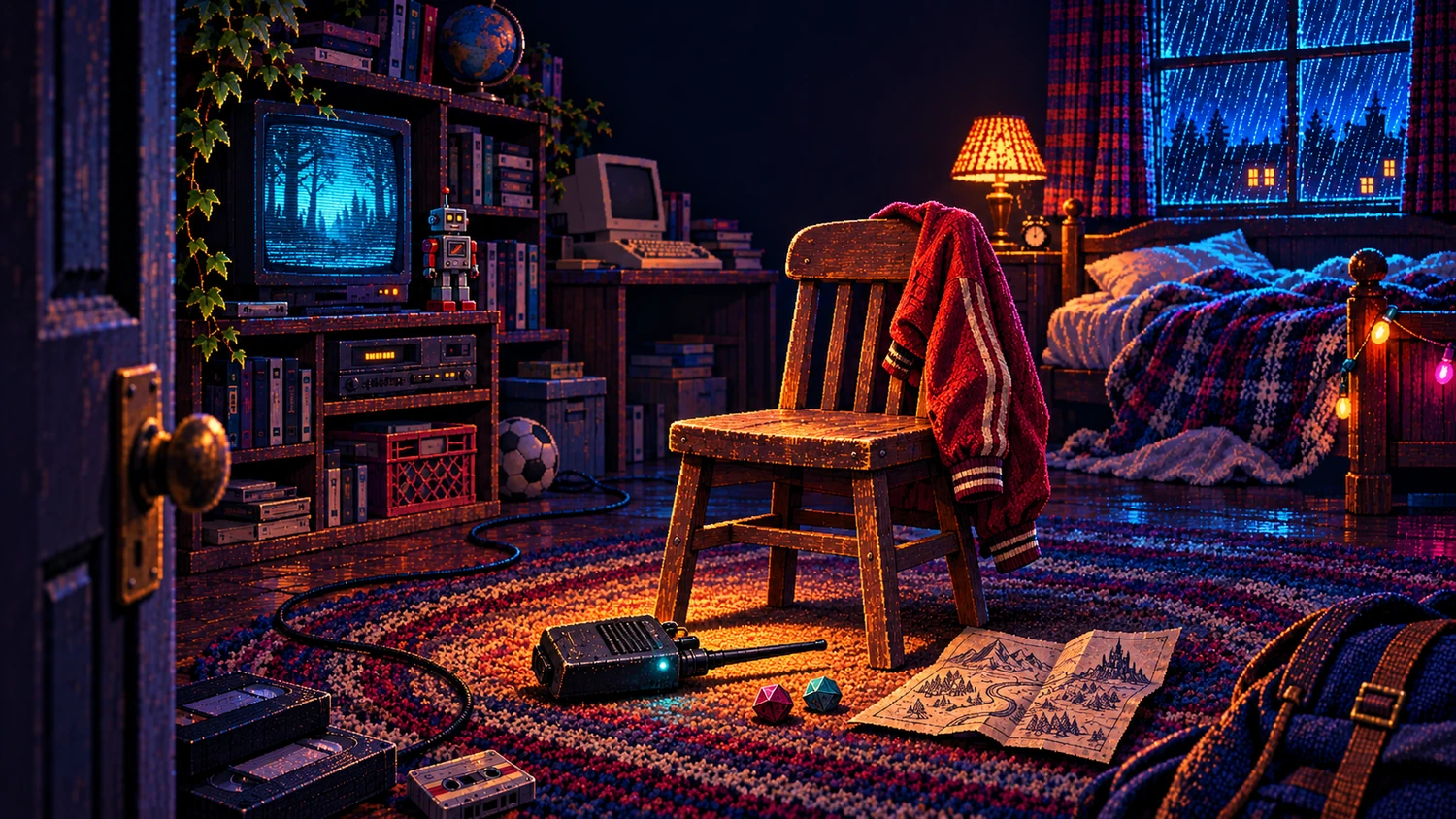
A bicycle ride home, a game interrupted by bedtime, a friend who does not arrive: the beginning of Stranger Things builds its mystery out of routines small enough to recognise. The scale can grow because the first task stays legible. Find Will.
The Nerd Calendar marks the occasion on November 6. This article looks at the storytelling of the first season, rather than attempting to explain the mythology of the entire series. Spoiler note: it discusses Season 1, including Joyce’s lights and the search for Will. It reveals no later-season plot developments.
Why is Stranger Things Day on November 6?
The date belongs to the story’s internal calendar. Netflix’s official explanation of Stranger Things Day ties the annual fan celebration to Will’s disappearance on November 6, 1983. It is an anniversary of a fictional event that viewers have adopted as a real occasion to return to Hawkins.
Keep two clocks separate. The series itself debuted on July 15, 2016, as Netflix confirms in its tenth anniversary retrospective. November 6, 2026 is therefore a fan day in the show’s tenth anniversary year, and falls 43 years after the fictional disappearance. It is not the fortieth or forty-third birthday of the television series.
The calendar’s shorthand about a missing boy is a starting point, not a complete chronology of police procedures. The firmly documented November 6 connection is the disappearance. A plot date, a streaming premiere and a recurring celebration answer different questions.
An absence gives every storyline a direction
A missing person creates an unusually efficient dramatic structure. We understand the goal before we understand the threat. The story can withhold explanations about the laboratory and the strange world beside Hawkins without withholding the reason to care.
Will also belongs to several different social worlds. His friends know him through play and loyalty; Joyce knows the habits of her son; Hopper approaches the case through investigation. Netflix’s Season 1 recap documents those intersecting searches. The useful observation is how the series lets each group hold a different part of the problem.
This is our reading of the season’s construction: its suspense depends on the distance between what each group knows. A clue can be convincing in one room and almost impossible to explain in another. The audience moves between those rooms, carrying connections that the characters cannot yet share.
That arrangement makes the town feel larger without requiring a bigger map. School, home and the police investigation are different systems of trust. Bringing information from one into another takes persuasion. Even a correct observation needs someone willing to listen.
Dungeons & Dragons gives the friends a shared language
The opening game establishes a group before the search breaks it apart. It shows the children negotiating rules, danger and one another’s decisions. Netflix’s cast rewatch notes add a fitting production detail: the Chapter 1 Dungeons & Dragons scene was filmed on the first day of shooting.
The game is also a way of making uncertainty discussable. A frightening thing becomes easier to argue about when friends can give it a name and sketch a possible rule. Naming does not make their model scientifically complete. It gives them somewhere to begin.
That difference is part of the pleasure. We watch the friends test an explanation rather than simply receive the correct answer. Their imagination has practical value because they can share it. Someone proposes a model; someone else doubts it; the group tries to decide what it would predict.
A reader does not need a rulebook to follow this. The important knowledge is social: these friends already know how to think together. Losing a member of the group turns that ordinary skill into an urgent one.
The lights turn a familiar room into a question
Joyce’s Christmas lights are memorable because the materials are familiar. In the first-season recap, Netflix describes her arrangement of lights and an alphabet as a means of receiving messages from Will. The object that usually supplies atmosphere now appears to carry information.
Watch the change in attention. A room that might once have been background becomes something to inspect. A flicker invites a question: coincidence, malfunction or a response? Once the possibility of a message exists, waiting itself becomes action.
We can read this as a compact expression of the season’s central problem. Contact is imaginable, but explanation remains incomplete. A sign that someone is there does not tell us how to reach them. Hope and uncertainty can therefore occupy the same shot.
NerdSpot’s look at Stephen King’s unsettling ordinary objects explores a related effect: a familiar environment becomes frightening when its expected behaviour changes. The comparison helps describe a technique; it does not require every resemblance to be treated as a documented borrowing.
Analog communication creates visible effort
Walkie-talkies fit this world because sending a message is an action we can see and hear. A character holds a device, speaks, listens and waits. The pause matters. Silence can mean an empty channel, an absent friend or something the speaker cannot interpret.
The point is not that older technology was always less reliable or that a smartphone would solve every fictional mystery. It is that these particular props give the series a clear rhythm of attempt and response. Communication occupies space and time.
The 1980s setting therefore does more than display collectible objects. It lets distance become a felt experience. Characters need to move, carry what they have learned and decide whom to trust with it. As in Hitchcock’s management of suspense, the timing and distribution of information are part of the drama.
Three things to notice on a November 6 rewatch
- Follow the unanswered question. At each change of scene, notice which search has advanced and which group still lacks that clue.
- Watch before naming the reference. Ask what a bicycle, game piece or radio does in the scene. Nostalgia has more force when the object also changes an action.
- Listen to the waiting. Notice how pauses make an attempted connection feel fragile before another image explains it.
These are viewing prompts, not hidden rules that explain every shot. They offer a way to revisit a familiar season without turning the evening into a hunt for continuity trivia.
The date remembers a relationship
November 6 lasts because it gives fans a small, precise doorway back into the story. Before Hawkins becomes a body of lore, it is a place where someone has failed to come home and other people refuse to stop looking.
That is the opening’s durable achievement. Will’s absence makes friendship visible through what people do: search, listen, improvise and keep a place for him. Stranger Things Day returns to the moment when all of that becomes necessary.