
Alfred Hitchcock at 127: How the Suspense Machine Works
A bomb is only a shock until the audience knows it is under the table. On Alfred Hitchcock’s 127th birthday, we open the machine and examine how information, looking, sound and space make viewers generate their own suspense.
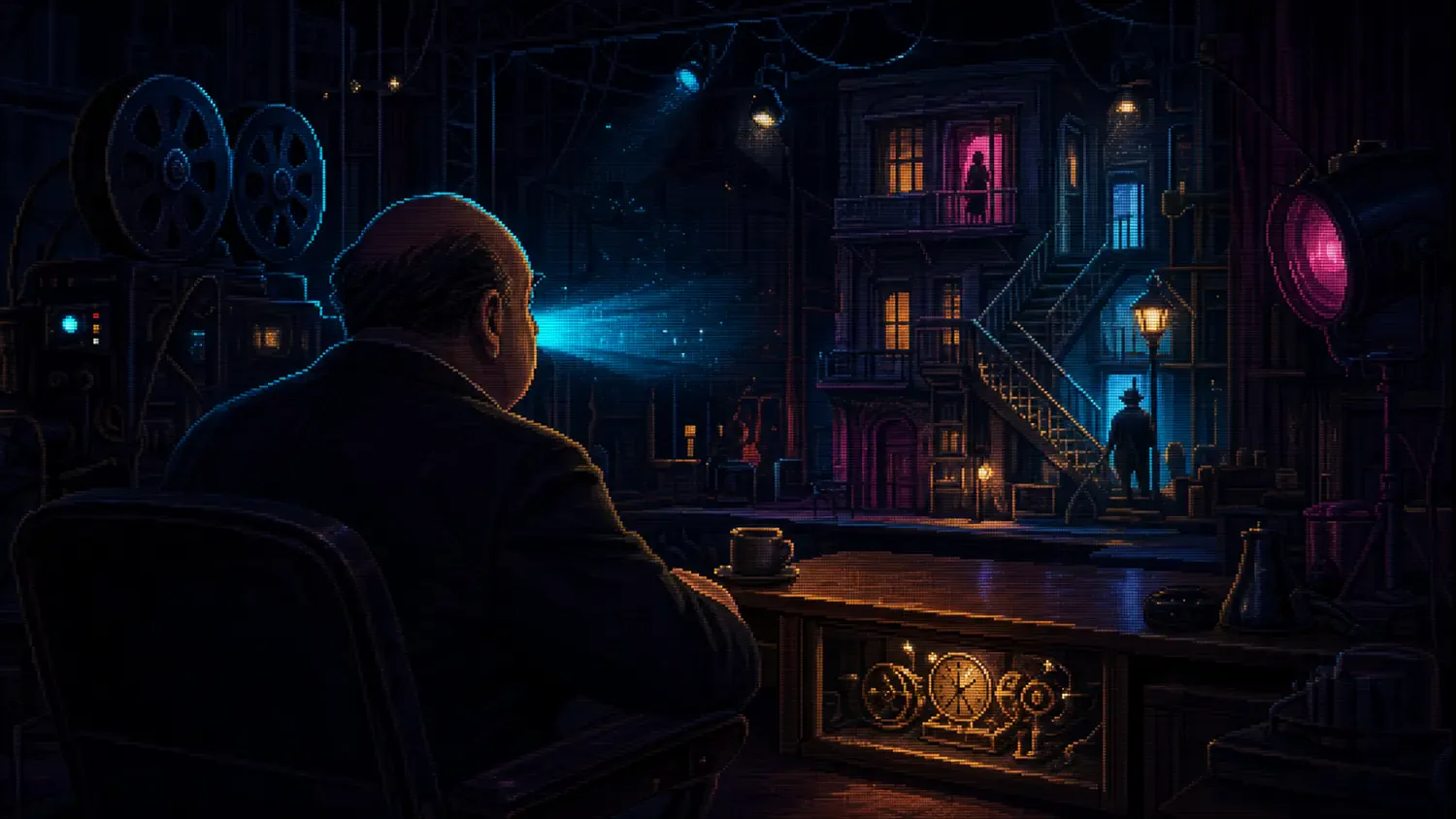
Alfred Hitchcock was born in London on 13 August 1899. The date returns in the Nerd Calendar every year, but his films offer more than a reason to replay the familiar “Master of Suspense” label. They invite a technical question: why can a sequence remain tense when we already know the danger?
The answer is that Hitchcock rarely treated the audience as a passive container waiting to be startled. He designed what viewers know, what characters know, where the camera permits us to look and how long we must wait. Suspense emerges in the gap between those pieces. The monster may be invisible, the crime may already have happened and the plot’s prized object may hardly matter. What matters is the mental work the film makes us perform.
Suspense begins with an information advantage
In a surviving 1963 Cannes interview preserved by France’s Institut national de l’audiovisuel, Hitchcock separates surprise from suspense with his famous bomb example. If people talk for several minutes and a hidden bomb suddenly explodes, the audience receives a brief shock. If viewers know the bomb is present and the characters do not, every ordinary word becomes urgent.
The clever part is not the explosive. It is the transfer of information. Once the film gives us superior knowledge, we start forecasting: Will somebody notice? How much time remains? Can an interruption save them? A harmless conversation becomes unbearable because the audience is running a simulation of possible futures.
This principle explains why a Hitchcock film can reveal more than a conventional mystery would. Suspense does not always depend on hiding the culprit. Sometimes identifying the danger early creates more emotional pressure, because knowledge arrives without control. The viewer can see the system and cannot reach into it.
Rear Window turns looking into an interface
Rear Window makes that relationship almost diagrammatically clear. Photographer L. B. Jefferies is confined to his apartment, so the courtyard outside becomes his screen. We look at him, then at what he sees, then back at his reaction. That rhythm converts windows into selectable fragments of other lives.
The British Film Institute’s film record highlights the picture’s point-of-view construction and its fascination with obsession, city life and the danger of the gaze. The tension works because our access is powerful and incomplete. We can scan the set, collect details and build a theory, but we remain trapped at the same distance as Jefferies.
That makes the courtyard feel surprisingly modern. It resembles an information interface: multiple live feeds, limited perspective and a user who mistakes observation for mastery. Hitchcock gives us the pleasure of noticing and then makes that pleasure ethically uncomfortable. We are not merely solving a murder puzzle; we are caught enjoying the act of watching strangers.
Space is never neutral
Hitchcock repeatedly turns locations into machines that control attention. The staircase in Vertigo stretches into a visual expression of Scottie’s fear through the famous combination of moving camera and changing lens perspective. The crop-duster sequence in North by Northwest removes the expected shadows and alleys, exposing its target in a flat, bright landscape. The Bates house in Psycho looms above the motel as if the architecture itself were withholding an answer.
These spaces are legible before they become dangerous. We understand the route, the height, the open field or the closed door. That clarity lets the director alter one element and make us feel the entire geometry tighten. Good suspense needs orientation: if we cannot model the room, we cannot fear what may cross it.
Vertigo is especially revealing because its suspense is tied to repetition. Places return, costumes return and gestures return, but never with exactly the same meaning. A BFI analysis of the film describes how Hitchcock uses familiar narrative conventions to position the spectator before breaking those expectations. The film does not simply conceal a solution; it makes recognition itself unstable.
Sound can show what the camera withholds
The mechanics are not only visual. In Blackmail, one of the early landmarks of British sound cinema, a repeated everyday word becomes an acoustic needle pressing on a character’s guilt. In Psycho, Bernard Herrmann’s strings do not realistically imitate the shower attack; they give its cuts a violent nervous rhythm. In The Birds, electronic sounds and carefully shaped silence refuse the comfort of a conventional musical score.
The Academy’s Hitchcock collection preserves production material from his remarkable run of Vertigo, North by Northwest, Psycho and The Birds, including notes on design, storyboards and sound. Together they show suspense as collaboration and engineering, not a mystical gift applied at the last moment.
Silence matters just as much. Removing a reassuring score can make the audience search the soundtrack for evidence. A distant footstep, a telephone or an unnatural absence of noise becomes a prediction trigger. Again, viewers are not waiting idly. They are listening ahead.
The plot object can be less important than the chase
Hitchcock popularised the term “MacGuffin” for the document, secret or object that motivates characters even when its details are secondary to the audience’s real experience. The stolen money in Psycho initially appears to power the story, then the film performs its most radical redirection. The transaction mattered because it moved Marion Crane to the Bates Motel; the suspense machine can discard it once a more disturbing system takes over.
That economy also drives the “wrong man” stories. A protagonist is assigned an identity by police, spies or circumstance, and the audience must track two realities at once: what the hero knows and what the surrounding system believes. The pressure comes from incompatible information states.
Why Hitchcock still feels native to games and streaming
Modern games use the same grammar whenever the player sees a threat on a security feed, learns that an enemy patrol is approaching or crosses a space whose layout promises an ambush. Interactive control changes the equation, but suspense still depends on carefully limited knowledge. Give players nothing and danger feels arbitrary; give them everything and it becomes a calculation. The sweet spot is enough information to form a plan, with enough uncertainty to fear its failure.
Serial television also thrives on managed asymmetry: one character knows the truth, another walks into the room and the viewer understands the collision before either can prevent it. Hitchcock did not invent every one of these devices, but he demonstrated their film grammar with unusual clarity. His sequences remain useful because they can be reverse-engineered.
The lasting trick is responsibility
Hitchcock’s cinema is often described as manipulation, and that is accurate—but incomplete. The best sequences do not merely push buttons. They make us complicit. We watch too closely, assume too much, hope a guilty person escapes or discover that a camera position has aligned us with an uncomfortable desire.
At 127 years from his birth, that is the more interesting legacy than any silhouette or catchphrase. Hitchcock understood that suspense is not simply danger delayed. It is information turned into responsibility. Once we know the bomb is there, the film has made it our problem—and the audience completes the machine.