
Marie Curie: How an Ore That Was Too Radioactive Revealed New Elements
On November 7, 2026, Marie Curie’s 159th birthday, the familiar story is two Nobel Prizes. The more revealing story begins with a measurement that did not fit: how could a uranium ore be more radioactive than its uranium content explained?
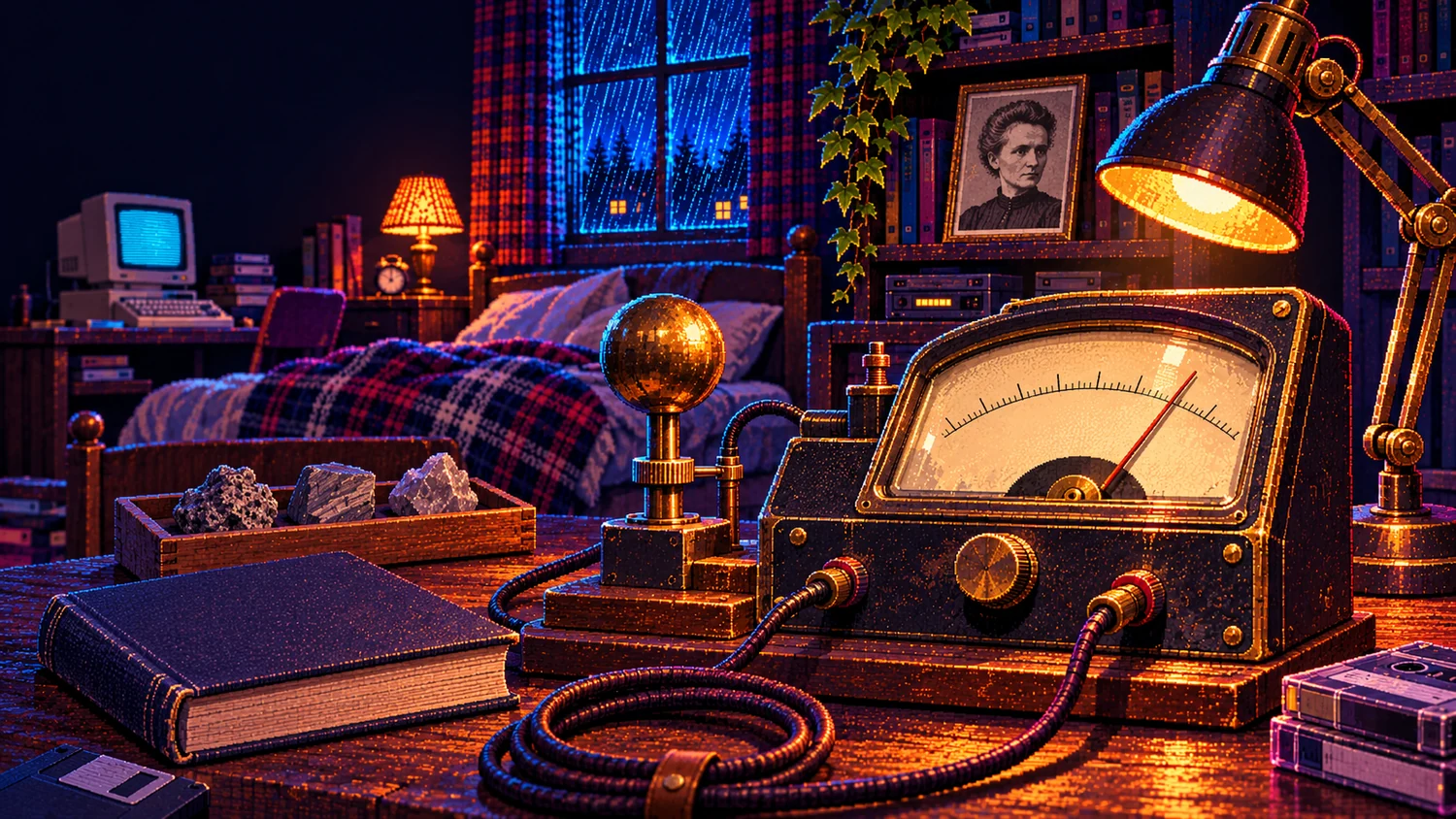
Imagine being handed a mixture and discovering that it produces a stronger signal than the ingredient you thought was responsible. You could distrust the instrument, invent a special property of the mixture, or ask whether something is missing from your inventory. Curie made the last possibility testable. Her route to radium and polonium was a sequence of comparisons, checks and separations.
First, make the invisible measurable
Henri Becquerel had discovered uranium radiation in 1896. Curie began studying it systematically in 1897. Her question was wider than whether a particular sample could affect a photographic plate: how much activity did different substances produce, and what determined it?
The key was the effect radiation has on air. Ionizing radiation frees electrical charges from atoms and molecules. Place the air between metal plates held at different electrical potentials, and those charges can move, producing a very small current. Under controlled measuring conditions, that current provides a way to compare the activity of samples. The Musée Curie’s explanation of the ionization chamber shows how this conversion works.
This was not a Geiger counter counting separate clicks. The apparatus measured the collective electrical effect of radiation. Our article on why a Geiger counter clicks explores the later approach. In both cases an invisible interaction becomes an observable signal, but the instruments do different jobs.
A crystal made the comparison more precise
The Curie method combined an ionization chamber, a sensitive electrometer and piezoelectric quartz. Pierre and Jacques Curie had discovered piezoelectricity in 1880: deforming certain crystals produces electric charge. In the measuring arrangement, a controlled mechanical load on quartz supplied a predictable charge that could balance the charge from the chamber.
That gave the experiment a reference. Instead of merely noticing that an indicator moved, the researchers could compare the unknown electrical effect with a controlled one. The museum’s account of piezoelectric quartz explains the connection between the load and the charge. This was precision built from mechanical skill, insulation, timing and patient observation.
For a modern reader, the lesson is concrete: a detector is only part of a measurement. You also need a reference and comparable conditions. A more dramatic signal means little if the sample arrangement or measuring procedure has changed.
The mineral that broke the expectation
Curie found that the activity of uranium compounds tracked the amount of uranium they contained. Changes of chemical combination did not make the activity disappear. That suggested a property associated with the element itself, rather than a special reaction between its chemical partners.
Then minerals upset the picture. Pitchblende and natural chalcolite could produce more activity than their known uranium content accounted for. In her 1911 Nobel lecture, Curie describes certain pitchblende samples containing 75 percent uranium oxide as roughly four times as active as that oxide. This is a comparison of particular samples under her measuring conditions, not a fixed multiplier for every piece of pitchblende.
The important point was the mismatch. Adding inactive material to an active substance should not, by simple dilution, make its measured activity unexpectedly greater. Something about the explanation was incomplete.
The control experiment that narrowed the answer
Curie prepared synthetic chalcolite from pure starting materials. It did not reproduce the excess activity of the natural mineral; its activity was consistent with its uranium content. Making a fresh version of the compound helped separate the effect of its chemical composition from the effect of something accompanying it in nature.
That distinction matters. The surprising measurement alone did not prove that a new element existed. The comparison made the hidden-substance hypothesis more credible and gave it a direction. If a strongly radioactive component was present in tiny quantities, chemical separation might concentrate it.
This is the part often lost in a biography built around awards. The discovery was not simply a brilliant guess. A guess became useful because it suggested another experiment that could have failed.
Separate, measure, follow the activity
Marie and Pierre Curie then used radioactivity as a guide through chemical analysis. Separate a material into fractions, measure the products, and find where the activity has gone. Repeat with the promising fraction. The signal could guide their work before they possessed enough of the unknown substance to characterize it conventionally.
Two different chemical tracks emerged: one associated with bismuth, the other with barium. In 1898 the researchers announced polonium and radium; the radium paper also credited Gustave Bémont. The original radium announcement preserves that collaboration.
Announcement and isolation were different milestones. Curie later used repeated fractional crystallization to separate radium salts from barium salts. The distinction was difficult because the substances behaved similarly in chemistry. Progress had to be checked by activity measurements and reinforced by other evidence, including spectral lines and atomic-weight determinations.
There is a useful connection with Lavoisier’s balance. The balance had made masses accountable; the electrometer let the Curies follow traces too small for ordinary weighing to reveal directly. A new measuring capability changed which questions chemistry could answer.
Read the notebook without adding a glow
Radioactivity in this story is not a visible green aura. It is inferred from physical effects and tested with instruments. The dangers were also not made obvious by appearance. A 2026 account from the Bibliothèque nationale de France explains how radioactive contamination reached the Curies’ papers during laboratory work and why the archive requires special conservation and consultation arrangements.
The notebooks therefore preserve two histories: the reasoning written on the pages and physical traces of the conditions in which those pages were used. The archive makes the labor tangible without turning exposure into a romantic badge of scientific dedication.
The birthday lesson: take the discrepancy seriously
The Nerd Calendar marks Curie’s birth on November 7, 1867. Her 1903 Nobel Prize in Physics, shared with Pierre Curie and Becquerel, and her 1911 Chemistry Prize belong to the story. But the practical achievement is easier to appreciate by following the evidence backward.
She had a comparable signal, an expectation, a stubborn exception and a control that narrowed the possibilities. Chemical work then turned a plausible explanation into evidence for new elements. On her 159th birthday, that is a legacy worth keeping close: when a trustworthy measurement refuses to fit, investigate what the explanation has left out.