
Maniac Mansion: Why Choosing Your Team Changes the Puzzle
Before you open a single door in Maniac Mansion, you have already changed the adventure. Dave’s two companions determine which talents enter the house—and which routes through its puzzles become yours. Thirty-nine years after its 1987 debut, that opening decision still deserves a closer look.
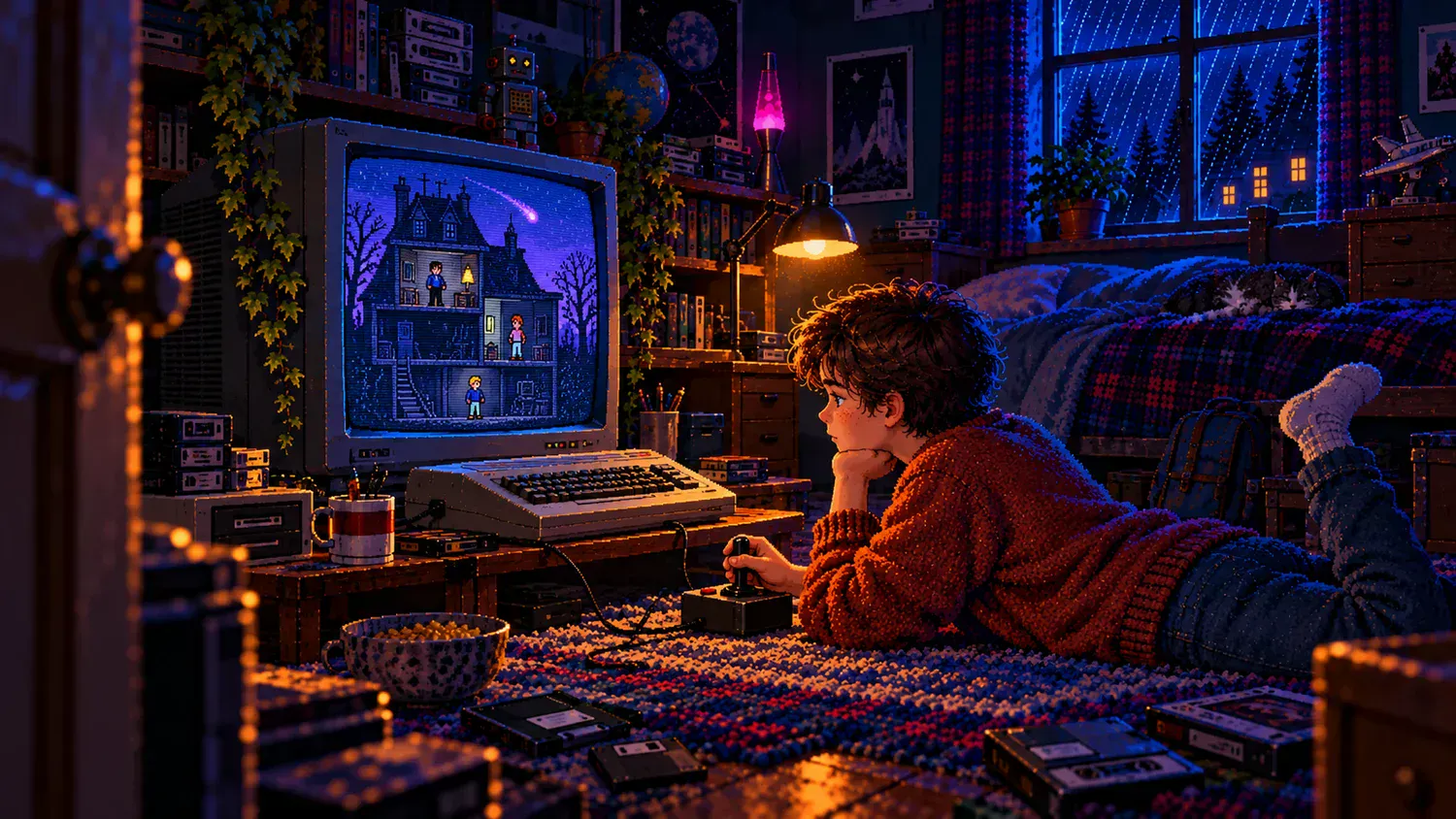
A familiar retro memory begins with a glowing screen, a strange house and the conviction that the answer must be hiding in a room you have already searched. Maniac Mansion adds a more interesting question: have you brought someone who can make use of what you found? Its characters are part of the problem-solving equipment, without being reduced to identical cursors in different clothes.
A 1987 game, a calendar date and an important distinction
The Nerd Calendar marks Maniac Mansion on October 5. Lucasfilm’s official retrospective confirms the original game’s 1987 release and its creators, Ron Gilbert and Gary Winnick. The primary sources consulted here do not establish October 5 as a universal first-release day. We use the calendar entry as today’s occasion, while keeping the historical claim at the supported year.
The premise is compact: Dave and two companions enter an eccentric household to rescue Sandy. Horror-film ingredients become opportunities for comedy and experimentation. That combination matters because an adventure needs more than atmosphere. It needs a reason for players to inspect unfamiliar objects, approach peculiar inhabitants and keep asking what could happen next.
Your team is a choice of possibilities
The original game manual, preserved by the Museum of Computer Adventure Game History, makes the rule unusually clear: Dave is always included, and you choose two companions from the other six. Every starting team can win, but the route and many puzzles vary with the combination. That gives fifteen possible companion pairs—not fifteen entirely separate games.
This is the useful distinction when someone asks for the “best” team. A character selection can open a particular approach without making every unchosen character necessary. If another player describes a solution that does not fit your group, the discrepancy need not mean you made a mistake at the selection screen. You may be looking at a different route through shared material.
As a design choice, this changes the meaning of replay. You do not only revisit rooms to remember where an item belongs. You revisit them with a different set of expectations. A space that previously seemed incidental can become relevant because the people entering it have changed. The architecture is stable; the interpretation is not.
One player, three positions in the house
You switch between the three selected characters, each with an individual inventory. The manual also explains that cut-scenes can reveal events elsewhere. Together, those features separate three things that simpler adventures often keep aligned: where the active character stands, where useful objects are, and what the player knows.
That separation is the heart of our reading of the game. You are not merely guiding a hero through a corridor. You are organising a small cast. A plan can involve one person waiting while another explores; an object matters partly because of who currently carries it. Changing the active character changes the immediate viewpoint, without erasing the larger situation you are trying to understand.
The result can feel like directing a scrappy horror comedy. The comparison is about the player’s attention, not a claim that the game is an interactive film. Watching a scene and deciding which character should act next are different activities. Maniac Mansion gets much of its energy from moving between them.
SCUMM made the design easier to express
SCUMM stands for Script Creation Utility for Maniac Mansion. In Lucasfilm’s history of the engine, Chip Morningstar’s suggestion to build a scripting language responds to the difficulty of implementing Gilbert and Winnick’s ambitious game. The system helped the team express rooms, characters and scenarios without repeatedly rebuilding the low-level machinery.
It is helpful to distinguish the tool from the interface. On screen, players combine visible action words with objects. Behind the scenes, scripting helps authors specify behaviour. One makes intentions easier to enter; the other makes situations easier to construct. They support the same adventure, but they solve different problems.
The broader lesson is practical: narrative ambition can create a demand for better tools. If a writer wants characters, objects and rooms to interact in many combinations, a workflow built around repeating technical setup becomes a creative bottleneck. SCUMM helped loosen that bottleneck. Its later use in games including The Secret of Monkey Island and Day of the Tentacle makes the mansion part of a longer technical history.
A branching house still had to fit on a disk
Gilbert’s published design notes complicate any tidy story of effortless invention. He describes a mansion map after substantial cuts, a 320K storage constraint and attempts to make the puzzle flow understandable. Some early concepts did not survive into the finished game.
That evidence gives the house a second meaning. It is both the fictional place you explore and a container the developers had to keep manageable. Reusing rooms across different character combinations creates variety without requiring an entirely new setting each time. That is our design interpretation, rather than a documented statement of why every room was retained.
Constraints alone do not guarantee elegance. They can also force awkward compromises. The surviving notes are valuable precisely because they show decisions in motion, before hindsight turns every limitation into a masterstroke.
Readable commands do not guarantee fair puzzles
Point-and-click input removes some uncertainty about how to phrase an instruction. It does not automatically tell you whether your plan is sensible, whether a clue was sufficient or whether an earlier decision has caused trouble. Interface clarity and puzzle fairness remain separate questions.
Gilbert acknowledged the distinction in his 1989 essay on adventure-game design, later republished on his blog. He criticised several frustrating design habits and explicitly included Maniac Mansion among his own imperfect work. The important historical point is not that an early classic solved everything; its creators continued learning from what failed.
For the later comic adventure tradition, read NerdSpot’s Monkey Island retrospective. Here, the mansion is most interesting as an experiment whose inventiveness and rough edges can be considered together.
Other languages: German · Spanish · French · Chinese · Japanese
Try a replay with one question in mind
Before starting, read the character biographies and choose a pair that interests you. Keep a small note of locations, who holds useful objects and which questions remain open. If you compare notes with another player, compare teams first. A walkthrough’s route may assume a different selection.
Then ask a narrower question than “What do I click?”: what does this team let me try? That shift captures Maniac Mansion’s lasting appeal. Its most intriguing door is the one opened by choosing who walks through the house with you.