
William Ramsay and the Noble Gases: Why “Inert” Can Still Glow
On October 2, 2026, William Ramsay’s 174th birthday, follow a puzzle hiding in ordinary air: why did two samples of supposedly the same gas weigh differently—and how did the answer lead to neon’s unmistakable glow?
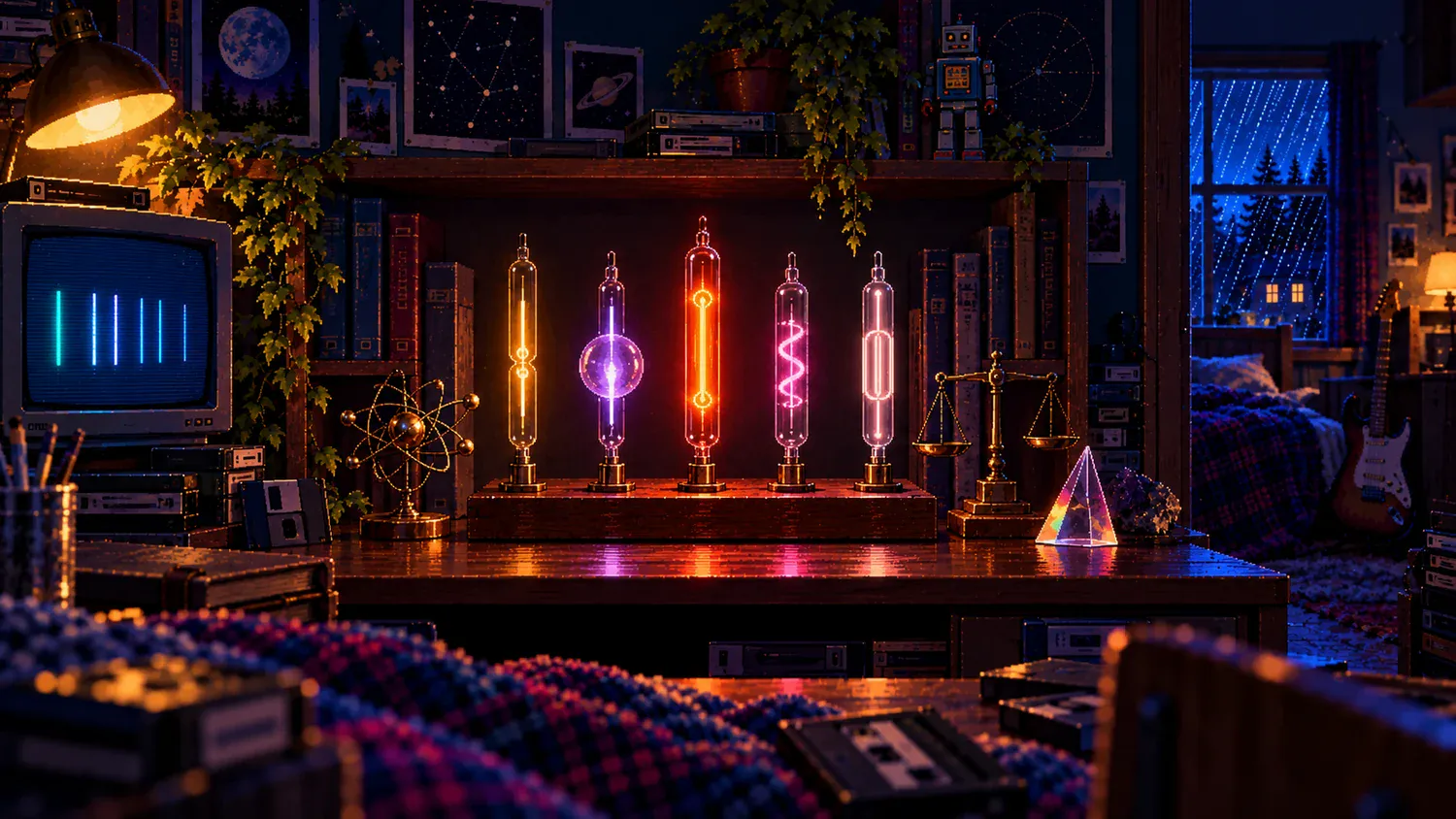
Picture a red-orange glass tube lighting a dark room. It looks like the opposite of doing nothing. Yet the gas inside belongs to a family once defined by its refusal to take part in chemical reactions. The apparent contradiction is the best route into Ramsay’s discoveries: a substance can be chemically reluctant and physically revealing at the same time.
This is not a story about a Victorian chemist inventing the glowing signs of the twentieth century. It is about how an unexpected measurement became evidence for an overlooked part of nature. The lighting came later. First, someone had to take a small disagreement seriously.
The nitrogen that would not weigh the same
Ramsay was born in Glasgow on October 2, 1852. The Nobel Foundation’s biography traces his career to University College London, where he took up a chemistry chair in 1887. His celebrated work on atmospheric gases grew out of a problem investigated by the physicist Lord Rayleigh.
Rayleigh compared nitrogen prepared by different methods. Gas obtained from air was denser than nitrogen obtained from chemical compounds. If both samples really contained only the same substance, under equivalent conditions, the preparation method should not have mattered.
His 1904 Nobel lecture makes the detective work unusually concrete. An initial difference of about one part in a thousand became one part in two hundred when he changed the preparation so that all the nitrogen came from ammonia. That is roughly half a percent. He did not simply make the awkward result disappear inside a generous error bar; he found a way to make it easier to investigate.
The distinction matters. A mismatch is not automatically a discovery. It could indicate contamination, a faulty assumption or an experimental problem. The productive question was which explanation would survive a deliberately different test.
Removing the familiar to find argon
Ramsay and Rayleigh pursued the possibility that the air-derived sample contained a heavier, unidentified gas. To isolate it, they removed the nitrogen. Ramsay’s route used hot magnesium; Rayleigh also worked with an electrical method. The remaining gas resisted the chemical reactions they tried.
They announced argon in August 1894. Crucially, this was a shared discovery, not Ramsay working alone in a moment of inspiration. Rayleigh’s density measurements and the separation experiments answered different parts of the same problem. In 1904, Rayleigh received the physics Nobel and Ramsay the chemistry Nobel.
The evidence also forced a change in what counted as worth noticing. A residue could look like failed purification. Here it became the thing that purification was meant to reveal. Readers of our Lavoisier story about weighing chemical change will recognise the larger theme: measurements do not merely confirm a theory; sometimes they expose what the theory has left out.
From one awkward gas to a whole family
Ramsay isolated terrestrial helium in 1895. “Terrestrial” is an important qualification: helium had already been identified through the Sun’s spectrum before it was isolated on Earth. The discoveries of neon, krypton and xenon followed in 1898, with Morris Travers playing a central role.
Instead of treating argon as an isolated oddity, the researchers looked for related gases. Differences in how gases condensed and evaporated made it possible to separate mixtures into fractions. Each fraction could then be examined for evidence of something new.
The Royal Society of Chemistry’s account of neon describes Ramsay and Travers collecting the gas that evaporated first from a cold argon sample under reduced pressure. Its brilliant red glow revealed a striking new candidate. This was systematic separation followed by identification—not the creation of an element from nothing.
That sequence is easy to flatten into a list of names and dates. Its real interest lies in the change of question: after finding one unexpected component of air, what other components might the same methods reveal?
Why a gas can resist chemistry and still emit light
Chemical reactivity concerns how atoms form or rearrange bonds. A discharge tube asks a different question: what happens when electrical energy is supplied to a low-pressure gas? Collisions can excite atoms. As excited electrons return to lower energy states, energy can leave as light.
No chemical burning is required. The light is evidence of energy changes within atoms, not proof that the gas has reacted with oxygen. Different allowed energy changes produce different wavelengths. Spread the light into a spectrum and you obtain lines that help identify the emitting substance.
That is why the tube is more than a colourful prop. UCL’s collection account describes Ramsay’s original discharge tubes and notes that they still glow when electrically excited. The objects connect the attractive visual effect to the practical work of collecting and investigating gases.
Our explanation of a Geiger counter’s clicks explores another instrument that translates an otherwise hidden process into a signal. A glowing tube and a clicking counter measure different things, but both remind us that the signal needs interpretation.
Two useful corrections to the neon mythology
First, pure neon in a discharge tube gives a characteristic reddish-orange light. “Neon” as a design label covers a much wider range of colours and technologies. A cyan tube, a purple sign or a neon-style LED decoration is not evidence that neon gas produces every colour. The retro palette is an aesthetic; the element has particular physical properties.
Second, “inert” is not an unlimited promise. Noble gases are generally very unreactive, but the heavier members can form compounds under suitable conditions. The RSC’s xenon history highlights Neil Bartlett’s 1962 breakthrough. The old family description was useful; treating it as an absolute law was not.
Neither correction diminishes Ramsay’s work. Both make it more interesting. Scientific categories organise observations, then change when new observations demand it.
The birthday lesson: investigate the remainder
The Nerd Calendar marks October 2 as Ramsay’s birthday. The strongest way to remember him is not merely to recite five gases. Remember the chain of reasoning: compare preparations, enlarge a discrepancy, separate a mixture and test what remains.
The glowing tube is the memorable ending. The beginning is quieter: two measurements that should have agreed, and researchers willing to ask why they did not.