
Celebrate Your Unique Talent Day: What the Demoscene Knows About Odd Skills
A tiny tune, a carefully placed pixel, a trick for making an old computer draw something surprising: each can seem like a very small talent. For November 24, the demoscene offers a better question than “Am I gifted?”: what could we make with it?
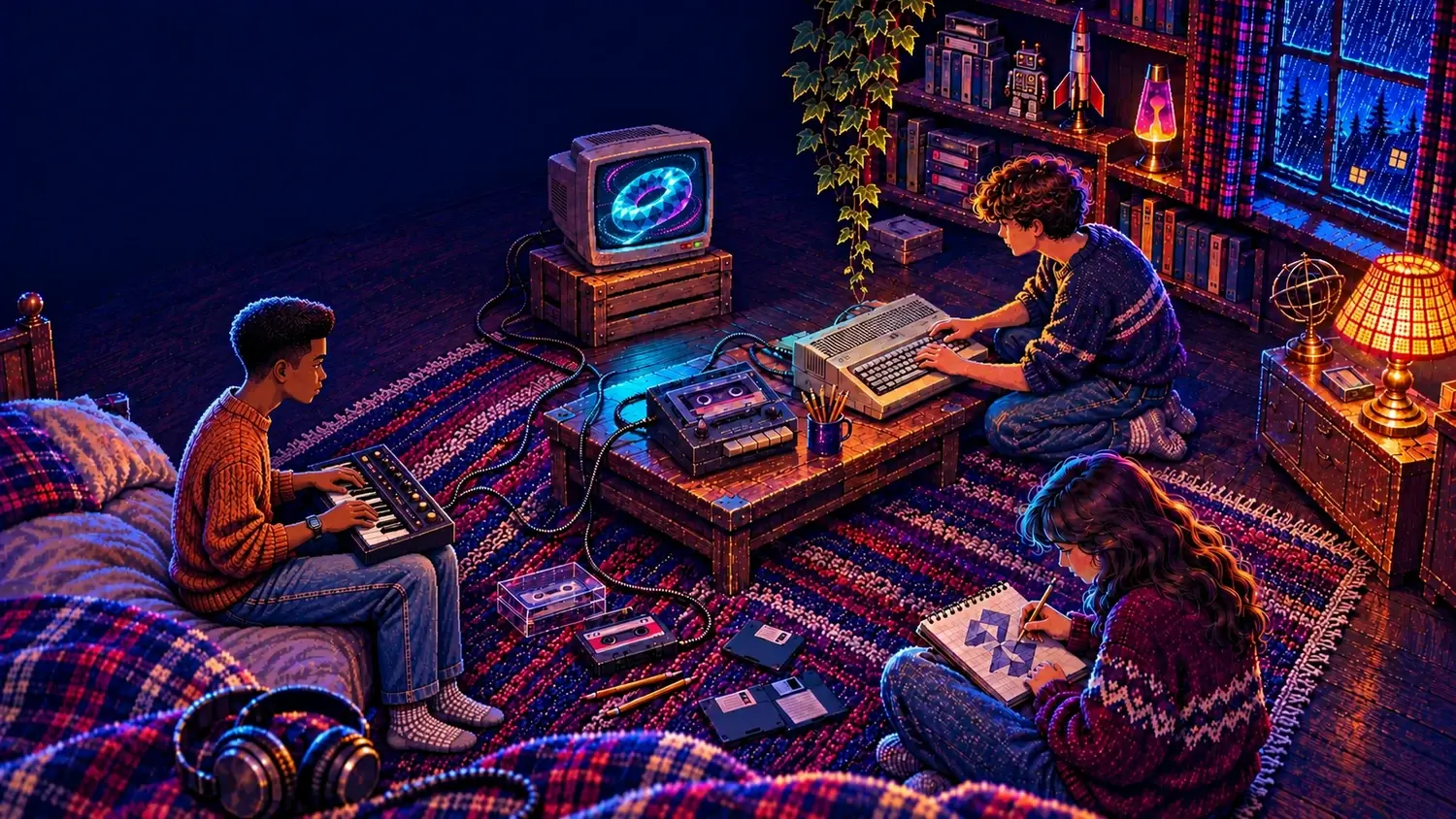
You probably know somebody who notices a wrong note immediately, organises an image into a handful of colours or enjoys squeezing a program into less space. Those abilities rarely fit the same talent-show category. Put them around one computer, though, and a different kind of performance becomes possible. The interesting unit is the finished work, with several kinds of attention inside it.
What happens on November 24?
The Nerd Calendar lists Celebrate Your Unique Talent Day on November 24. Time and Date also gives that date and describes an unofficial observance whose origins are unknown. In 2026 it falls on a Tuesday. A documented founder or official proclamation would require evidence we do not have.
That leaves plenty of room for an enjoyable interpretation. You do not need to prove that nobody else shares your ability. Pick something specific you like doing and give it a form another person can understand. Our suggestion is to borrow a working idea from a computer-art culture, without claiming that the culture is connected to the holiday’s origins.
A demo is a work, not an unfinished game
In the demoscene, a demo is an audiovisual work generated by a running computer program. Assembly’s introduction and historical showcase explains the combination of real-time graphics, code and music. Finland’s Assembly has hosted scene competitions since 1992, including separate graphics and music categories alongside demos and size-limited intros.
For a viewer, the first distinction is practical. You follow a demo’s unfolding presentation rather than steering a character toward a goal. Watching a video capture can introduce the artwork, but the capture records a program’s performance; it is not the same thing as executing that program. Keep that distinction in mind when a tiny download produces a surprisingly rich result.
For this talent day, the useful idea is the meeting of disciplines. One person can make an entire work; a group can also divide it into contributions. Neither arrangement requires every participant to be equally interested in every tool.
A small limit makes a skill easier to see
A concrete example comes from Revision 2026’s graphics rules: its 4k Executable Graphics category allows a program of at most 4,096 bytes to produce a still image. Animation and sound are excluded from that category. It is a specific challenge, rather than a size rule for all demoscene art.
The creative attraction is easy to imagine. If a program cannot carry a huge collection of finished pictures, its author must think carefully about how to describe a picture. A repeated form, a calculation or a well-chosen colour relationship can become more important than another stored asset. A limitation gives technical decisions a visible consequence.
Borrow that principle at a gentler scale. Try drawing an object using four colours or composing a melody with five notes. These are proposed exercises, not official competition requirements. A small boundary can make the next decision manageable: which detail communicates the idea, and which detail can go?
Combine strengths without inventing a lone genius
Imagine a thirty-second scene about rain at a bedroom window. One friend draws a small skyline. Another creates a short musical phrase. A third writes movement that makes a few bright pixels travel down the glass. Each can offer something specific while the group negotiates pace, contrast and the moment the scene ends.
This is a hypothetical project, but it shows why naming a contribution matters. “Creative” is broad. “Found the rhythm that made the final transition work” gives the group something to discuss and the maker something to develop. Listening, editing and explaining can also change the result, even when they produce no spectacular solo moment.
NerdSpot’s article on Steve Wozniak’s personal-computer engineering follows another route into purposeful technical craft. Here the focus is on arranging several interests into one presentation. Ask what each person wants to contribute before assigning a role based on what they did last time.
The hobby became cultural heritage
The German Commission for UNESCO records the demoscene’s inclusion in Germany’s nationwide inventory of intangible cultural heritage in 2021. This is a national inventory designation, not inscription on UNESCO’s World Heritage List.
The recognition offers a useful shift in perspective. A scene consists of people keeping a practice meaningful together. If you only admire the final spectacle, you can miss the work of making it understandable to somebody else. For a beginner, that second layer may be the most welcoming part: there are questions to ask before there is a masterpiece to make.
Look at the credits before comparing yourself
The community archive Demozoo documents productions, people and events. Use a work’s credits as a viewing aid: whose contributions are named? Then watch again with one element in mind, such as a transition or the relationship between an image and a musical accent.
Separate observation from explanation. “The change happens on the beat” describes something you can notice. A guess about exactly how it was programmed needs more evidence. Writing down that distinction makes curiosity more useful and gives you a precise question to investigate later.
A small project for Unique Talent Day
Set aside an hour for an experiment inspired by the scene. This is a friendly private exercise, with no competition standard to meet:
- Choose one thing to communicate. A turning planet, a sleepy robot or a rainy window is enough.
- Choose a modest boundary. Use four colours, a short musical phrase or one repeated shape.
- Make a contribution you can finish. A sketch, a few seconds of sound or a simple movement can stand alone.
- Combine and watch. Ask what becomes clearer when the parts meet and what still needs adjusting.
- Save and credit it. Keep a dated version and name each contribution. Share it only if everyone involved wants to.
If it breaks, record what you expected and what actually happened. Our Failures Day article explores that learning loop in more depth. A small unfinished experiment can still leave a useful sketch, an explanation or a better question.
Give a small ability somewhere to go
Celebrate Your Unique Talent Day does not need a ranking. The demoscene gives us a concrete way to think beyond one: an unusual interest can become a contribution, and contributions can become a work. On November 24, choose one thing you enjoy making, give it a small boundary and see what happens when somebody else’s skill meets yours.