
Egon Spengler: How Ghostbusters Makes the Supernatural Feel Like a Job
Egon Spengler’s most convincing invention is not a working ghost detector. It is a world in which a haunting can be investigated, contained and invoiced. The 1984 film’s equipment gives the impossible a procedure—and its comedy a remarkably solid foundation.
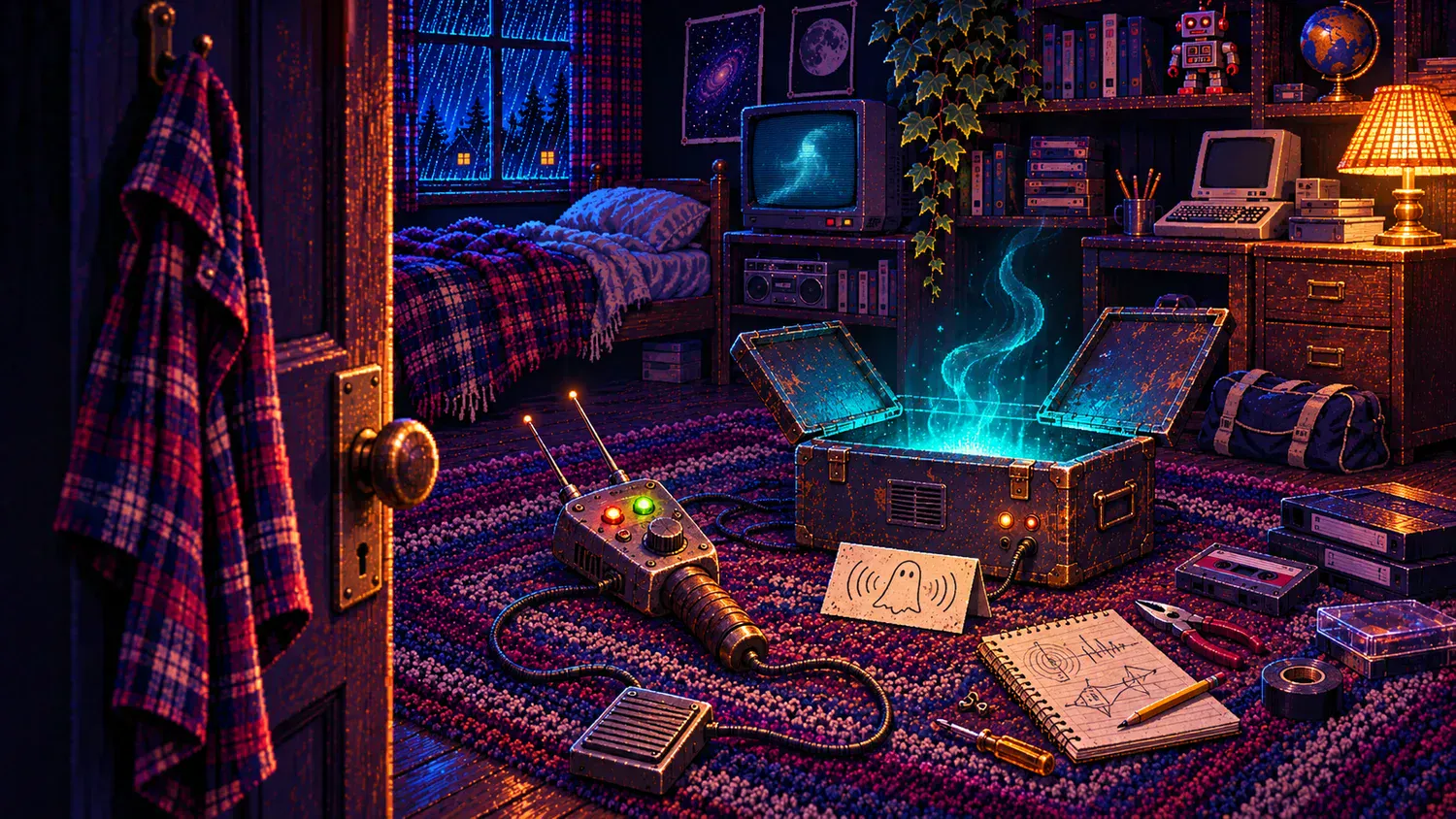
A ghost can pass through a wall. The people sent to deal with it still have to carry their equipment, find the right switch and avoid damaging the building. That mismatch is one of the pleasures of Ghostbusters: spectacular supernatural trouble meets the practical inconvenience of doing a job. Egon gives that collision its vocabulary.
Egon Spengler’s birthday on November 21
Harold Ramis plays Egon alongside Bill Murray’s Peter Venkman, Dan Aykroyd’s Ray Stantz and Ernie Hudson’s Winston Zeddemore. Sony’s official film page identifies the characters and dates the original film to 1984. Ramis also co-wrote the screenplay with Aykroyd, as Sony confirms in its 2014 anniversary announcement.
Egon Spengler’s birthday is November 21. His entry in the Nerd Calendar is a fitting occasion to revisit the scientist whose tools make ghost hunting feel like a real job.
The PKE meter makes attention visible
Egon is the team member who makes looking closely feel like an action. A device changes a quiet room into a place where something can be tracked. Before anyone understands what a disturbance means, the apparatus tells the audience that the characters have noticed it. A raised antenna, a flashing light or a sound is easier to read than a lecture about an invisible force.
The PKE meter’s appeal is partly mechanical. Its moving parts have direction and rhythm; its reactions invite us to compare one moment with the next. We do not need a trustworthy numerical scale to recognise escalation. The film can move from curiosity to unease while the people holding the equipment remain composed. That gap gives the scene room for a joke.
This is a reading of the film’s storytelling, not evidence for paranormal detection. A prop supplies a visible response because a scene needs one. An actual measurement would require a defined quantity, calibration and an independently testable interpretation. The resemblance to an instrument is precisely what lets the fiction borrow the authority of one.
Four different jobs, rather than one magic weapon
The kit becomes especially readable when its functions are separated: detect a disturbance, restrain a ghost, catch it in a trap, then place it in containment. This is our shorthand for the film’s workflow, not an official engineering specification. The important point is that finding the problem does not automatically solve it.
A proton stream creates a very different expectation from a meter. The meter asks where something is; the stream makes holding it a coordinated physical task. A trap adds timing and placement. Containment makes us think about what happens after a successful call. Each stage gives the characters another way to cooperate, hesitate or make a mess.
Compare a spell that resolves everything at once. These separate tools give an audience small, legible questions: has the target been located, is it held, is the trap ready? Even without understanding the invented physics, we can follow whether a procedure is succeeding. That clarity keeps an effects-heavy scene from becoming an indistinct exchange of bright lights.
Why the equipment looks better with a little inconvenience
Handles, cables, straps and worn surfaces imply that somebody has to use these things repeatedly. They suggest storage, transport and repairs. Such details make the Ghostbusters feel closer to a service crew than to visitors carrying immaculate technology from another civilisation. The supernatural remains extraordinary; the work surrounding it becomes familiar.
Egon’s restrained manner supports the same effect. Treating an impossible event as a practical problem gives the other characters something to push against. Enthusiasm, salesmanship and frustration can all bounce off his seriousness. The gadgets work as part of that performance: they make the serious person’s priorities visible without requiring him to explain himself every time.
A rule is valuable because the audience can remember it
The warning about crossing the streams is an unusually compact piece of fictional world-building. It gives a complicated-looking apparatus a memorable boundary. Viewers do not need the equations; they need to recognise that a choice carries a consequence. Later, deliberately crossing that boundary can become a dramatic decision rather than an arbitrary new effect.
The official Ghostbusters channel’s comparison of raw and finished footage shows the stream-crossing sequence as a constructed screen effect. For this reading, its interest lies in how clearly bodies and equipment prepare the action. The coloured energy finishes a decision the performers have already made understandable.
A replica can reproduce the performance, not the premise
The distinction remains useful outside the cinema. Hasbro’s official Two in the Box project describes a PKE meter collectible with motorised illuminated wings and a separate real-world EMF detection mode. It also describes a ghost trap with working doors and an activation pedal. Those are concrete features of a manufactured replica.
An EMF response does not establish a ghost, and theatrical lights do not turn a box into paranormal containment. What the replica can preserve is the choreography: point, observe, react, deploy. The pleasure is in performing a fictional job whose actions are unusually easy to recognise.
For another approach to evidence in supernatural fiction, our article on Scully’s skepticism in The X-Files asks what doubt contributes to a story. Egon provides a useful companion question: what changes when a film lets its characters proceed as though the extraordinary already has a maintenance manual?
What to watch for next time
On a rewatch, follow the handoffs between tools rather than only the ghosts. Notice when a reaction from a device replaces an explanation, when a rule creates tension and when carrying out a simple task becomes comic. The equipment is doing narrative work long before a beam lights up the room.
Egon makes the impossible feel approachable because it comes with a process. His lasting appeal is the idea that curiosity can pick up a tool, ask a useful question and start working—even while the rest of the room is panicking.