
Salami Day: Why Your Snack Is a Microbial Ecosystem
September 7 is Salami Day. The most interesting thing about the sausage is invisible: during fermentation, bacteria change their surroundings—and one another’s chances of survival. Research highlighted in 2026 gives this familiar snack a surprisingly rich scientific story.
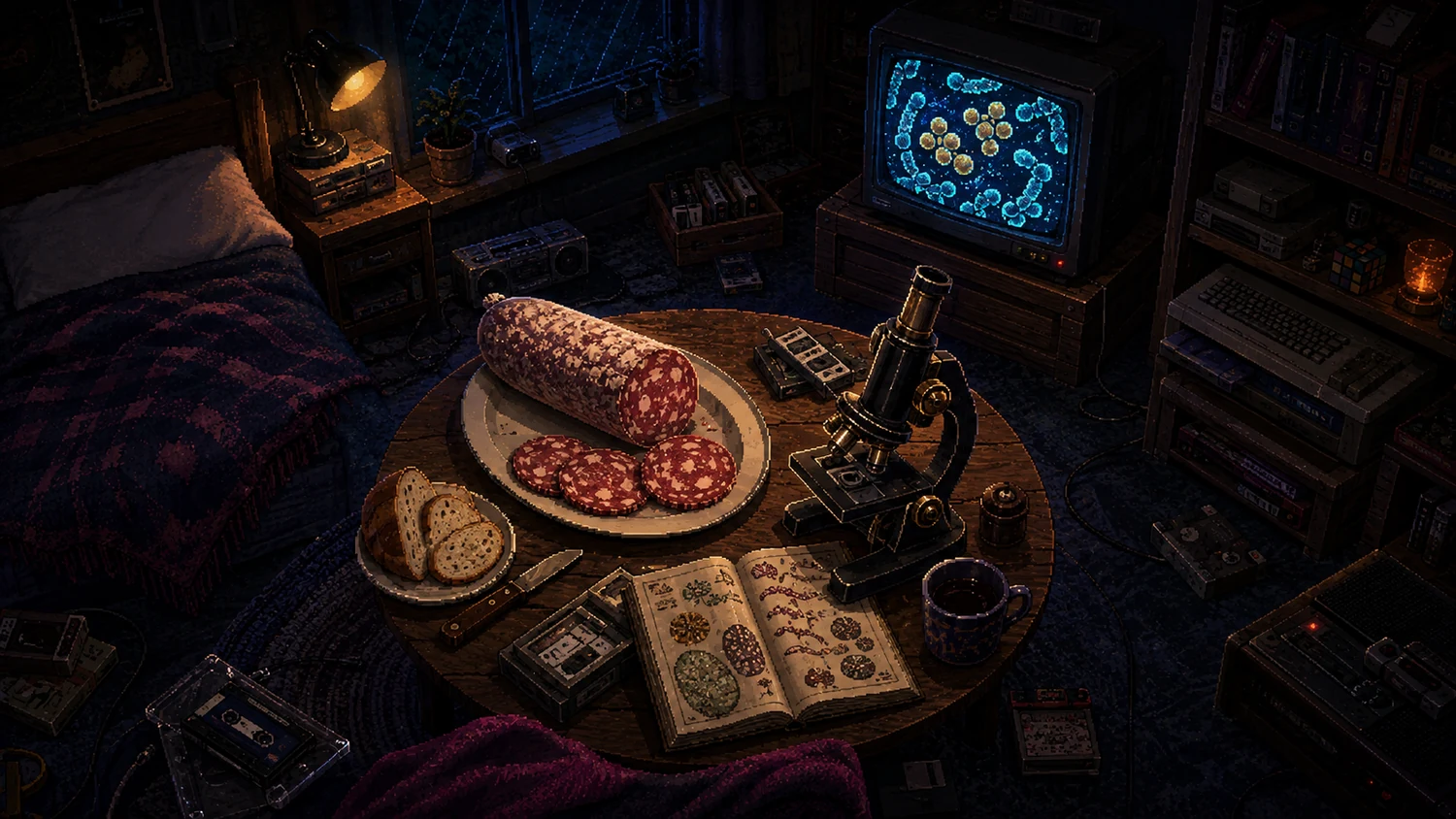
On the plate, the job appears finished: a firm slice, pale flecks of fat, a particular smell and perhaps a tangy bite. During production, however, fermented salami is a changing habitat. Understanding that habitat is a better way into its flavour than imagining that meat simply dries until it becomes something else.
September 7: a small holiday with a documented beginning
The Salami Day website traces the celebration to 2006 in Henrico, Virginia, where Virginia Roper and Christine Lucas founded the Salami Appreciation Society. It places the annual date on September 7, matching our Nerd Calendar. In 2026, that makes twenty years since the stated founding.
The organisers’ account is evidence for their own celebration, not an official international proclamation. Nor does a modern food holiday date the invention of salami. Keeping those questions separate leaves room for a more interesting anniversary question: what actually happens inside fermented sausage?
Fermentation and drying do different jobs
The American Society for Microbiology’s explanation of food preservation distinguishes processes that make food less hospitable to microbes from those that enlist microbial activity. Salt and drying reduce the availability of water. Fermentation changes the food through microbial metabolism.
Lactic acid bacteria can turn sugars into lactic acid. The resulting acidity lowers pH and contributes a sour or tangy taste. Water activity, meanwhile, concerns water available to microorganisms; it is not another name for acidity. These are different properties, even when they change during the production of the same food.
That distinction answers the basic puzzle. A fermented sausage can owe part of its character to organisms growing during a controlled process, while the changing conditions restrict other organisms. “Contains bacteria” is therefore far too coarse a description to explain what is happening.
The 2026 hook: who thrives in that changing habitat?
On May 27, 2026, Vrije Universiteit Brussel highlighted doctoral research by Ana Sosa Fajardo into bacterial interactions in fermented meat. The university describes organisms competing, cooperating and adapting as conditions change. Some inhibit competitors; others gain advantages through nutrient uptake or stress responses.
The work focuses on Staphylococcus shinii, including questions about which genetic capabilities become active during fermentation. The university presents better control of quality, flavour and safety as possible future benefits. It does not establish that a new process has already reached every salami on a supermarket shelf.
For a reader, the useful shift is from a list of ingredients to a set of relationships. Knowing which organisms entered the process is only the beginning. The environment they encounter, and the effects they have on their neighbours, matter too.
A genome is a map of possibilities
The related BMC Genomics paper was published on June 7, 2024, rather than in 2026. It examines the fermented-meat isolate S. shinii IMDO-S216. Researchers sequenced and analysed its genome, identifying one circular chromosome and eight plasmid replicons.
They found gene clusters associated with potential competitive advantages, including a cluster for the bacteriocin lactococcin 972 and others connected to functions such as iron acquisition and responses to antimicrobial peptides. The conclusions describe possible contributions to adaptation and competitiveness.
The cautious wording matters. Finding genetic instructions is not equivalent to demonstrating their activity under every production condition. Nor is one investigated strain a stand-in for every member of a species, every starter culture or every product. The 2024 paper and the 2026 doctoral-research announcement belong to the same research story, but they are different kinds of evidence.
Why a list of microbes cannot be a recipe for flavour
The paper’s background explains why some coagulase-negative staphylococci are studied in meat fermentation: organisms such as S. xylosus can contribute to colour and flavour, and selected strains may be introduced alongside acidifying bacteria as starter cultures. A starter is a chosen starting population, not a guarantee that all subsequent interactions become irrelevant.
Imagine a strategy game in which the terrain changes as the players move. That is an analogy, not a claim that bacteria plan their actions. It helps separate two ideas: possessing a capability and benefiting from it in a particular environment. A list of units would not tell you the whole outcome; a list of organisms does not tell the whole fermentation story either.
Three questions to take away from the next slice
You do not need a home laboratory to read the subject more carefully. Three distinctions do most of the work:
- Process or ingredient? A description of fermentation tells you something different from a list of spices.
- Observation or explanation? A tangy taste is an observation. Identifying which organisms and reactions produced it requires evidence.
- Potential or demonstrated result? A gene, a laboratory finding and a measured outcome in a finished product are different steps.
These distinctions also put a boundary around the science: neither a pleasant smell nor the word “fermented” certifies a particular product’s safety. This is an explanation of production biology, not a method for making or testing raw-meat ferments at home.
The science hiding in an ordinary object
NerdSpot’s account of John Dalton’s colour-vision puzzle follows another gap between an observation and its explanation. Salami offers a less solemn version of the same invitation: notice something ordinary, then ask what evidence would explain it.
For Salami Day 2026, the worthwhile discovery is not a miracle bacterium. It is that a familiar food emerges from a controlled, changing microbial community. The finished slice looks simple because the complicated part happened earlier.