
John Dalton’s Colour Blindness: The Theory His Own Eyes Disproved
On September 6, 2026, John Dalton’s 260th birthday, his most revealing experiment starts with a mistake. He thought a blue filter inside his eyes explained his unusual colour vision. Testing that idea took his investigation beyond his lifetime—and eventually into the DNA laboratory.
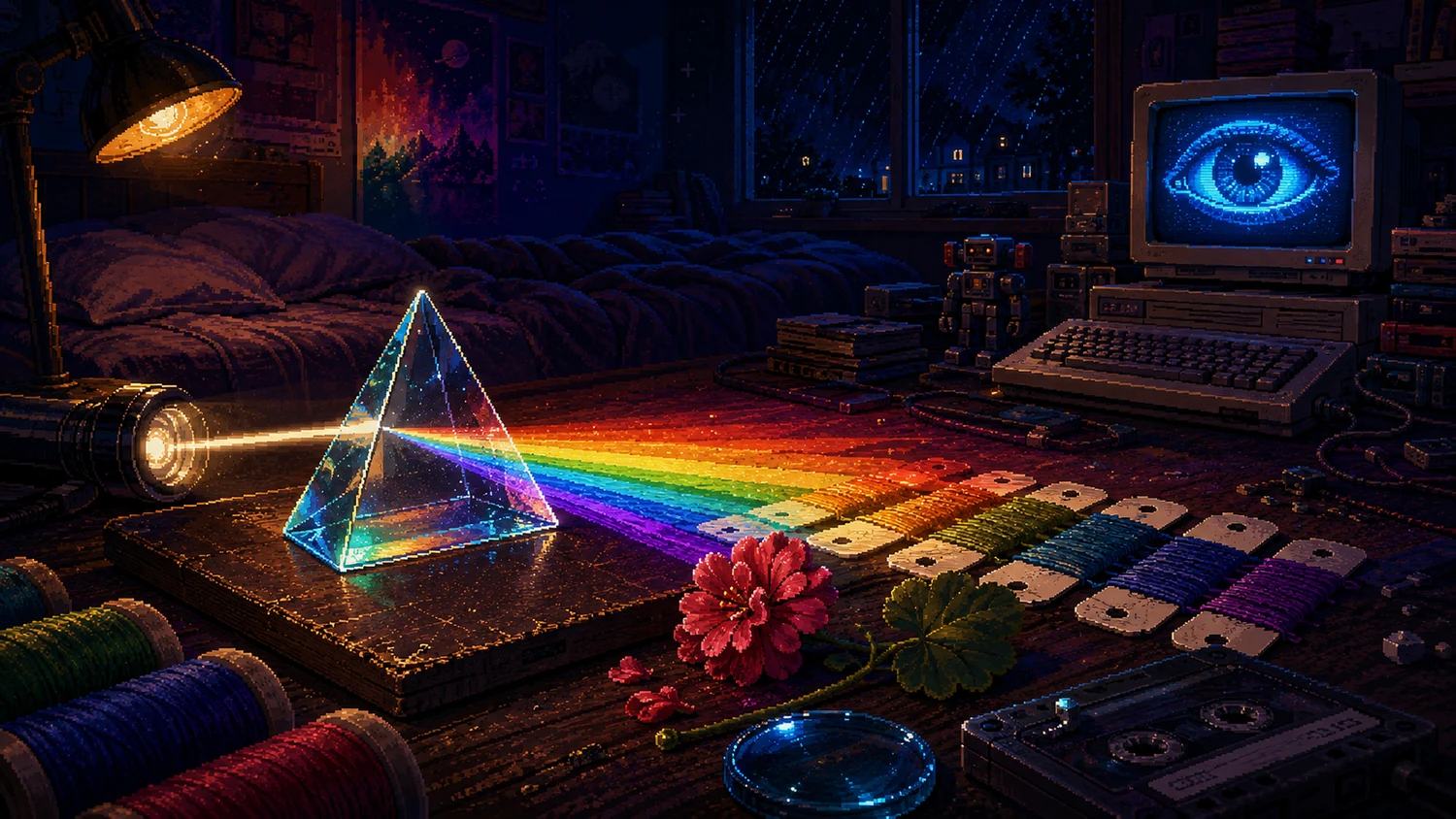
Dalton’s name usually sends us towards atoms. This anniversary takes a smaller object seriously: a pink flower. What happens when a scientist realises that the colour everyone else describes is not the colour he experiences? His account offers an unusually close view of the gap between observing something accurately and explaining it correctly.
The flower that changed under candlelight
In his original account of colour vision, pages 28–31, Dalton describes an incident from autumn 1792. A geranium flower looked almost sky-blue to him by daylight. Under candlelight, its appearance shifted towards what he called red. Expecting others to notice the same striking change, he asked them to look. They did not report what he did. His brother was the exception.
Notice how the discovery begins. Dalton did not wake up knowing that his perception differed. He had already wondered whether people used colour names sensibly. Pink and blue seemed closely related to him; placing pink near red sounded less convincing. A disagreement about words could therefore hide a disagreement about seeing.
The flower supplied a better question than “Which name is correct?” It let him compare the same object under different illumination and ask several observers about the result. The object, the lighting and the observer became separable parts of the problem. That is a useful experimental move even before anyone knows what happens inside an eye.
A shared vocabulary can conceal a different experience
Dalton opens his paper with a surprisingly familiar puzzle: people may talk successfully about the same objects while experiencing them differently. Learning that a familiar object is called red does not grant access to another person’s sensation of red. Everyday conversation can continue without exposing that difference.
His botanical observations made the problem harder to overlook. He records asking whether flowers were blue or pink and finding that people sometimes thought he was joking. Read today, the passage asks something of the listener too: an unexpected description can contain information. Dismissing it as carelessness closes the investigation before it begins.
This is why his brother’s similar response matters within the narrative. It turns an isolated disagreement into a comparison worth pursuing. It does not, by itself, explain the mechanism. Dalton still needed to distinguish the pattern he had found from whatever theory he would build around it.
1794 was the presentation; 1798 was the printing
The surviving text records a reading on October 31, 1794, before the Manchester Literary and Philosophical Society. The collected publication appeared in 1798. Those dates refer to different stages of the same work. The digitised copy’s opening page preserves both clues, so a timeline need not force them into a single “discovery date”.
Dalton organised his investigation into his own vision, similar observations in other people and possible causes. He also examined a spectrum produced with a glass prism in a dark room. Where other observers distinguished several colour regions, he described only two or at most three broad divisions, using yellow, blue and purple as his terms.
Those are historical reports in Dalton’s vocabulary, not a universal conversion chart. They should not become a claim that every colour-blind person sees the same replacement colours. Even in his own account, the lighting changes the comparison. The interesting evidence lies in which distinctions collapse or remain visible under particular conditions.
The blue filter was an explanation, not an observation
Dalton proposed in his original paper, page 43 that the vitreous humour—the transparent, gel-like material inside the eye—had a blue tint. This would act as a filter on incoming light. He arranged for his eyes to be examined after death.
The proposal has an intuitive appeal. Put coloured glass in front of a scene and its appearance changes. But an analogy is only the beginning of an explanation. If the proposed filter is a physical feature inside an eye, examining that material should give the idea a chance to fail.
That is what makes this episode more than a charming mistake by a famous scientist. A theory can be imaginable and still be wrong. Its value depends partly on whether it tells someone what to look for. Dalton left behind a question that another observer could address without needing to share his private experience.
What the examination found—and what DNA added
The Science and Industry Museum records Dalton’s birth on September 6, 1766. After his death in 1844, Joseph Ransome examined his eyes and found their fluids clear. The proposed blue filter was absent. Preserved material nevertheless remained available for later study.
A DNA study published in Science on February 17, 1995 identified Dalton as a deuteranope: he lacked the retinal photopigment sensitive to middle wavelengths. The explanation concerned light detection in the retina, rather than a blue filter in front of it.
The order matters. Finding no filter rejected one explanation; it did not automatically supply the later answer. A negative result and a positive identification are different achievements. Keeping the earlier observations and physical material made it possible to ask a new question with a new method.
Nor does the result replay Dalton’s visual experience for us. A biological finding and a written description provide different kinds of evidence. Together they can constrain an explanation without turning a modern screen into a window through another person’s eyes.
A useful lesson for games, diagrams and interfaces
Dalton’s story suggests a practical question for anyone designing a puzzle or reading a chart: what information survives if two colours are difficult to distinguish? Consider an imagined game in which two equally shaped gems have different powers but differ only in colour. Adding distinct silhouettes would give the player another way to recognise them.
The W3C’s guidance on the use of colour states the corresponding accessibility principle: colour should not be the sole visual means of conveying information. Shapes, text and other visible cues can carry the distinction too.
The historical connection is an editorial one, not a claim that Dalton designed modern accessibility rules. His account reminds us why a designer’s own experience is insufficient evidence that a signal works for everyone. A disagreement can reveal something about the design rather than a failure to pay attention.
A birthday worth celebrating with an unanswered question
Our article on Lavoisier and the chemical balance follows another route from observation to explanation. For Dalton’s birthday, the memorable instrument is the comparison itself: a flower, two lighting conditions and people who disagree about what they see.
His blue-filter theory did not survive. His observations did. That is the stronger anniversary story: a carefully recorded puzzle can remain useful after its first explanation has failed, and after the person who asked the question can no longer answer it.