
Why Does a Geiger Counter Click—and What Can’t It Tell You?
Hans Geiger was born on September 30, 1882. On his 144th birthday, follow the signal behind his famous namesake: a tiny interaction becomes a loud, countable pulse, but the click does not carry a complete description of the radiation.
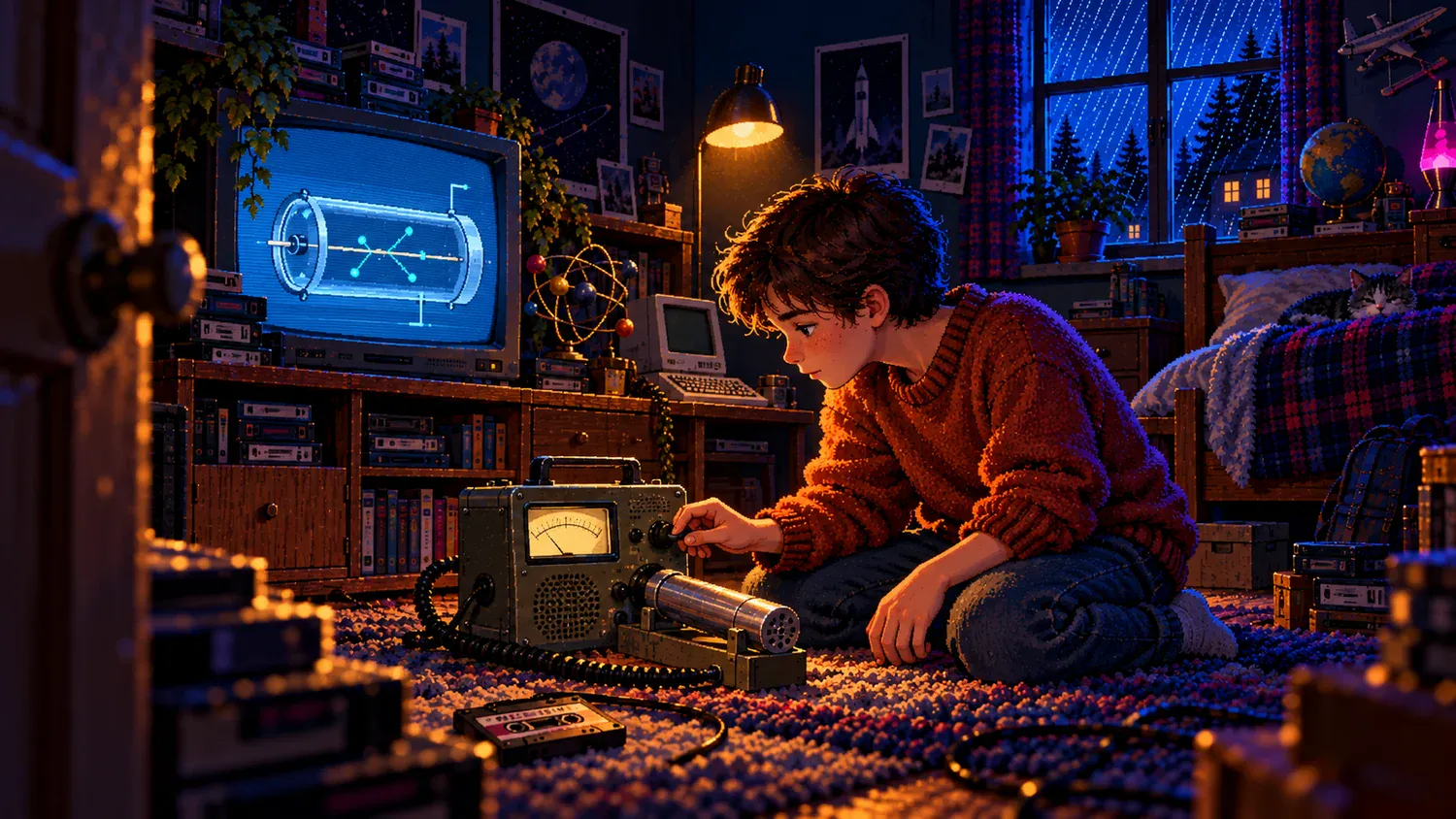
A Geiger counter can make an ordinary room sound eventful. A few isolated clicks, an uneven pause, then another small burst: the instrument gives our ears access to a process we cannot directly sense. It is tempting to treat that sound as radiation itself. In fact, we are hearing an electronic translation.
The distinction opens a better birthday story than a list of inventions. What has to happen before a click exists? Why does the device count so well while answering some other questions poorly? And why should a detector’s silence be interpreted as carefully as its noise?
Three dates that should not become one invention
The biographical account in Mayo Clinic Proceedings records Geiger’s birth on September 30, 1882, an early alpha-particle counter in 1908, and the Geiger–Müller instrument in 1928. The last name matters: Walther Müller was a collaborator, not an optional footnote to the device’s name.
These milestones belong to a developing research programme. Calling everything “the invention of the Geiger counter” hides the difference between an early way of registering alpha particles and the later tube associated with the familiar instrument. A birthday marks a person; it does not give a technology a single, uncomplicated starting point.
There is another story nearby. Geiger and Ernest Marsden’s scattering work helped Rutherford reach the nuclear model of the atom. CERN Courier’s historical account separates the 1909 measurements from Rutherford’s 1911 interpretation and describes counting flashes on a fluorescent screen. Do not picture that experiment as someone waving a modern clicking handheld counter at gold foil.
Inside the tube: turn a small event into a large signal
A typical cylindrical Geiger–Müller tube contains gas, an outer electrode and a central wire, with a voltage between them. An interaction that produces ionization supplies mobile charges. In the strong electric field, electrons can trigger further ionization. The resulting cascade becomes an electrical pulse large enough to register.
ORAU’s Museum of Radiation and Radioactivity explains an important detail: alpha or beta particles entering through a suitable window can ionize the gas directly, whereas gamma rays commonly initiate the process through an interaction in the tube wall. “Radiation enters a box and makes a sound” skips the part that makes the instrument interesting.
The useful analogy is a doorbell. A small action starts a much more noticeable response powered by the apparatus. That does not make a detector literally a switch, but it helps separate the initiating event from the signal produced to announce it. The electronics do the announcing.
The speaker is the final translator
The pulse can be counted, displayed and routed to an audio circuit. When audio is enabled, registered events become clicks. Turn off the speaker and the underlying measurement need not stop. There is no miniature physical knock that the instrument is simply amplifying from the surrounding air.
The US Nuclear Regulatory Commission’s introduction also explains why a counter can register background radiation without a deliberately placed source. A quiet bedroom is not a radiation-free reference chamber. The uneven rhythm is therefore not automatically evidence that a mysterious object has appeared nearby.
For a listener, the sound is wonderfully immediate: something registered here, then something registered again. That immediacy is also a trap. Our brains want to turn a short burst into a story before we have considered the observation period, the detector or the background.
A count is a record, not an identity card
The basic Geiger signal does not identify the original source, radiation type or energy by the sound of an individual click. The large pulse makes an event easy to detect, but it does not retain the detailed energy information needed for spectroscopy. A louder speaker does not mean more energetic incoming radiation.
Imagine a turnstile recording twenty passages. The total does not reveal the visitors’ names, how much luggage they carried or how many people walked past without entering. Likewise, the counter’s record describes registered events in a particular detection system. It is not a census of every nuclear decay in the room.
That is why identical count rates from two different instruments should not automatically be treated as identical measurements of the environment. The tube, its window, its response and the measurement geometry all belong to the result. The number becomes meaningful with its method attached.
Counts per minute are not a universal dose conversion
CPM means counts per minute. As a simple arithmetic example, 120 registered counts collected over two minutes average 60 CPM. Nothing in that division identifies a radionuclide or calculates a person’s radiation dose.
ORISE’s guide to detecting radiation explains why background readings and consistent measurement conditions matter. Turning a count rate into another physical quantity requires the relevant response and calibration. Some properly designed GM instruments can indicate dose rate within specified conditions; that is additional measurement work, not a universal meaning hidden inside each click.
A useful habit is to read the unit before reacting to the number. Then ask which detector produced it, for how long, at what distance and against what background. A screenshot showing a large numeral but none of that context has thrown away much of the measurement.
Try the counting idea without a radiation source
You can explore the difference between individual events and an average with a coin. Make six groups of twenty tosses, recording heads in each group. Treat a head as a pretend registered event. Compare the groups before adding them together.
This is a counting analogy, not a physical simulation of radioactive decay: coin tosses happen in scheduled trials, while decay events are not coordinated to your table. Its modest lesson is still useful. Short samples can look uneven even when you have not changed the procedure. A different total is a reason to examine evidence, not an automatic explanation of its cause.
Keep the same discipline when fiction uses a detector to build tension. Our look at Fallout 3’s escape from Vault 101 examines how a game teaches us to read an unfamiliar world. Real measurements require us to learn the instrument’s language too.
Listen to the question the instrument can answer
The Nerd Calendar gives September 30 its occasion. Geiger’s lasting connection to the counter gives us something more useful than a birthday fact: a lesson in making the invisible measurable.
The click is powerful because it makes a registered event unmistakable. It becomes misleading only when we ask it to supply an entire explanation. Hear the event, count it carefully, and keep the detector’s limits alongside the result.