
Talk Like a Pirate Day: Why Does a Pirate Sound Like That?
September 19 is International Talk Like a Pirate Day. Before the first “arrr” leaves your mouth, try a stranger question: whose voice are you borrowing? The trail leads to Robert Newton’s Long John Silver in the 1950 film Treasure Island—and to a performance that became easier to recognise than its source.
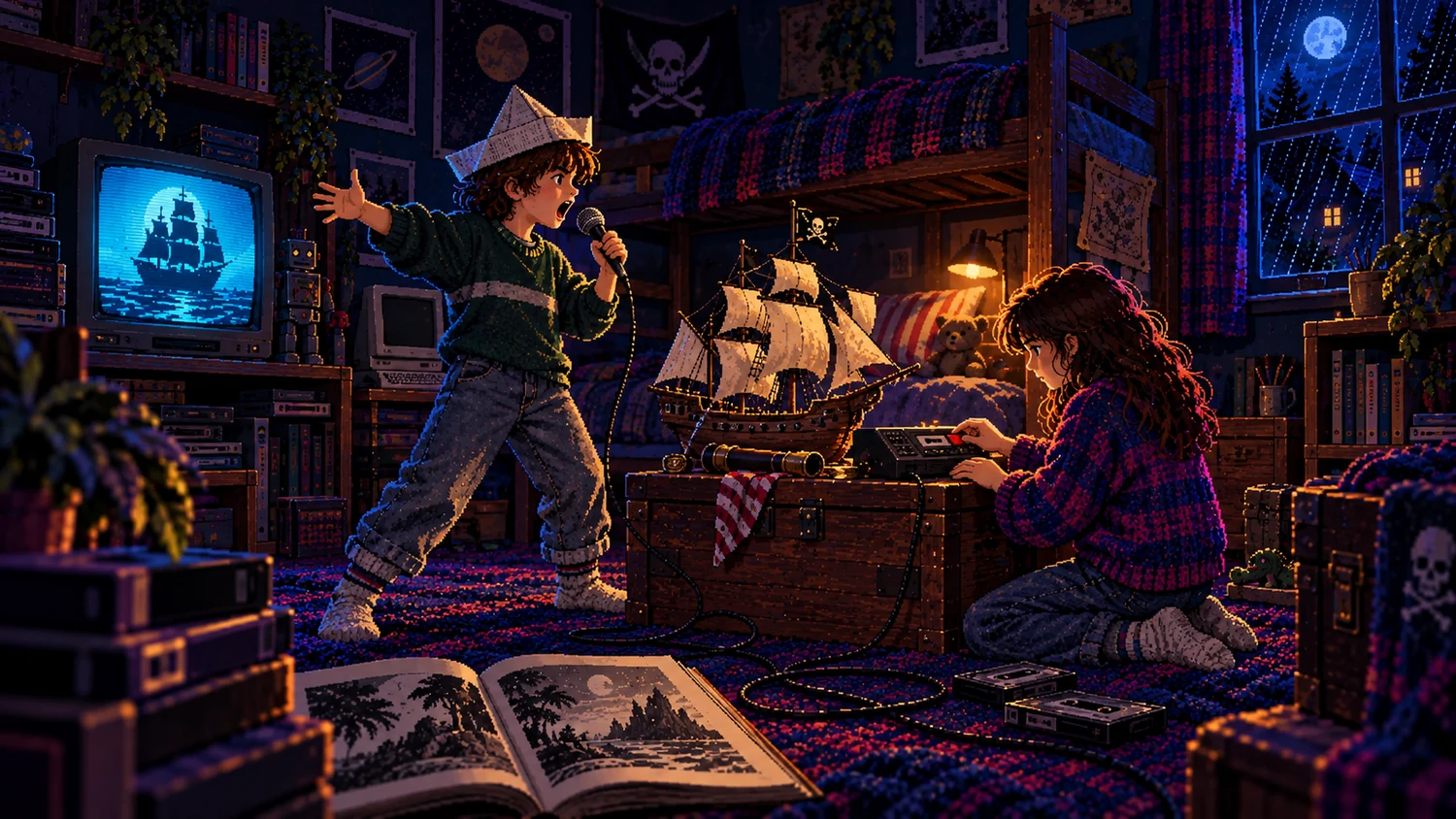
For September 19, 2026, the interesting challenge is not to assemble the longest list of pirate phrases. It is to listen to the costume hidden inside a voice. A greeting, a growl and an exaggerated rhythm can announce an entire fictional world before anybody mentions a ship. How did that shorthand become so familiar?
A holiday with two beginnings
Founders John Baur and Mark Summers date the idea to 1995; Dave Barry’s column brought it wider attention in 2002. The annual celebration falls on September 19.
Those dates describe different things. One marks a private invention; the other marks its public amplification. Calling 2002 the moment of wider recognition does not erase the earlier joke. Likewise, the date in the Nerd Calendar is the chosen celebration day, not the anniversary of a famous pirate battle.
That distinction matters when a playful custom becomes a calendar fact. A neat birthday is easy to repeat, but often hides the steps that made an idea travel. Here the invitation requires almost no equipment: try a voice, let somebody recognise it, and see whether they answer in character. Participation carries the joke forward.
The film behind the familiar voice
Royal Museums Greenwich traces the stereotypical West Country pirate voice to Disney’s Treasure Island (1950), with Robert Newton as Long John Silver.
The careful word is stereotypical. This is an account of a performance tradition. It does not establish that every historical pirate sounded like Newton, or that he invented every nautical expression. Treating a memorable screen voice as a recording of the past would confuse the evidence with the thing it represents.
Disney’s D23 entry confirms Newton’s role and identifies the film as the studio’s first entirely live-action feature. It is a useful production record; it is not a linguistic survey of seafarers.
Try separating the ingredients as you listen: pronunciation, vocal texture, rhythm and vocabulary. A regional accent is one layer. A theatrical growl is another. A nautical word supplies a third. Everyday imitation bundles them together until “pirate” feels like a single sound rather than several choices made by a performer.
How a movie voice travels beyond its movie
There is a concrete link beyond the screen. The Walt Disney Family Museum recounts that lyricist X Atencio consulted Treasure Island for pirate jargon while working on the Disneyland attraction Pirates of the Caribbean.
That small detail is more revealing than a sweeping claim that one film created all modern pirates. It shows a specific act of reuse: an artist went back to an earlier work to find a usable tone. We can identify that step without inventing a complete family tree for every later pirate character.
Our reading is that a successful genre voice works like a compact stage prop. It quickly tells an audience how to interpret a scene. Recognition does not require remembering the original actor. Somebody can imitate an imitation, retaining the signal while losing the credit. The holiday makes that process visible because the audience becomes the performer.
Words on a page do not come with one compulsory voice
Open Robert Louis Stevenson’s Treasure Island at Project Gutenberg and choose a short exchange. Read it silently before hearing an adaptation. Which voice did you supply yourself?
A printed line leaves room for choices about pace, stress and the distance between friendliness and threat. An actor must settle those choices for one performance. A later reader may then hear that performance internally, even though the page did not prescribe every feature of it.
This is a useful comparison, not a claim that the book contains no vocal clues. Look at the actual wording. Then distinguish what the text supplies from what your memory adds. Familiarity can make the addition feel so obvious that it becomes difficult to notice.
A pirate is a role, not a universal accent
When we ask whether somebody sounds like a pirate, we may really be asking whether they match the fiction we know. That is a question about recognition. Asking how a particular person spoke in a particular port and period is a historical question that needs different evidence.
The distinction becomes clearer across languages. An English regional pronunciation does not simply transfer into German, Spanish, French, Chinese or Japanese. A playful local version can use a nautical greeting, an exaggerated command or a deliberately grand manner without claiming to reconstruct an English accent.
For a party or a tabletop game, start with intention. Is your invented captain boasting, bargaining, hiding uncertainty or trying to keep an unruly crew together? Let that decision shape the delivery. Repeating one noise after every sentence may announce the costume, but it leaves little room for a character.
A five-minute experiment for September 19
- Write one ordinary message. Announce that the snacks are ready or ask who has the map. Keep the meaning simple.
- Perform it in three ways. Use your normal voice, a theatrical captain’s delivery and a quiet, conspiratorial version. These are your inventions, not historical quotations.
- Change one ingredient. Keep the words but alter the rhythm; then keep the rhythm and change a word. Notice which cue does the most work.
- Ask what was recognised. Did your listener imagine a film, a game or an unnamed storybook pirate? Recognition is the observation, not proof of historical accuracy.
For another kind of pirate wordplay, revisit our Monkey Island retrospective. It looks at an adventure in which dialogue becomes part of play. Our Talk Like Yoda Day article offers a related example of fans stepping into a fictional voice. Neither connection proves a line of influence; both make useful comparisons.
Enjoy the voice—and remember where the evidence ends
Talk Like a Pirate Day works because a tiny performance can open a shared imaginary world. Knowing about Newton does not spoil that pleasure. It adds a name and a film to something that can otherwise feel as if it has always existed.
This September 19, give your captain something worth saying. Then keep the two stories distinct: the documented history of a screen convention, and the much larger history of people at sea. A convincing “arrr” can start the game. Curiosity about its source makes the game more interesting.