
Super Mario Bros. World 1‑1: How a Level Becomes a Teacher
On September 13, 2026, Super Mario Bros. turns 41. Its first level still poses a surprisingly sharp design question: how do you teach a newcomer to trust a mushroom after a mushroom-shaped enemy has just punished them?
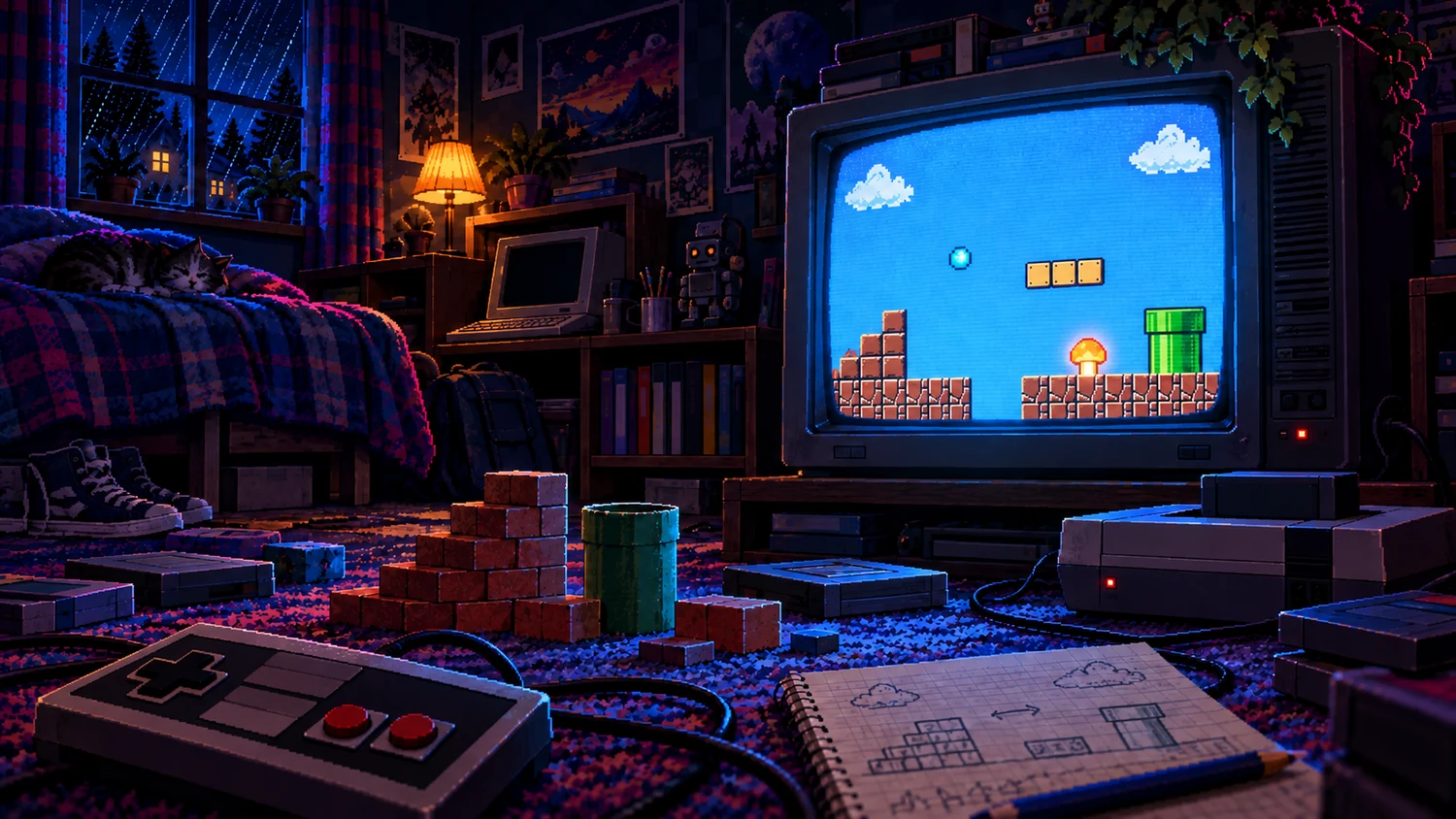
You remember the blue sky, the opening music and the temptation to run. Familiarity makes this scene look almost self-explanatory. Remove decades of Mario knowledge, however, and the screen becomes a collection of unanswered questions. Which things are solid? Which moving objects hurt? What happens if you touch something from above rather than from the side?
September 13 celebrates a specific release
Nintendo dates the original Japanese Famicom release to September 13, 1985. That makes today its 41st anniversary. This is a release anniversary, distinct from the March 10 celebration covered in NerdSpot’s earlier Super Mario Day article.
The Nerd Calendar supplies the occasion; the opening stage supplies a better question than another list of franchise milestones. What does a game have to arrange before a player can discover a rule? The following is a design reading of World 1-1, anchored in Nintendo’s developer interviews. It is not a claim that every player has the same first experience.
The screen offers problems before explanations
Consider the opening as a sequence of decisions. The available space invites movement. An approaching enemy makes doing nothing consequential. Blocks above the route make the air relevant as well as the ground. Several apparently separate objects now participate in one question: what can a jump accomplish?
That is more economical than teaching each object in isolation. One action can change your position, avoid contact, produce a collision above your head or land on something below. The player is building a vocabulary of relationships. A block is not merely a picture of a block; its significance depends on what you can do to it.
This reading also explains why familiarity can hide the work. An experienced player recognises a useful pattern immediately. A newcomer must discover which relationships matter before speed or precision can even become meaningful goals. The same screen is a warm-up for one person and an investigation for another.
The mushroom asks you to revise a rule
In Nintendo’s interview with Shigeru Miyamoto, the design problem is explicit: beginners could mistake the helpful mushroom for another threat. The opening therefore encourages an encounter that reveals its benefit.
The basic distinction is concrete: a side-on collision with a Goomba is dangerous, while landing on it defeats it. A Super Mushroom makes Mario grow; as Super Mario, he can break bricks. Nintendo’s original manual documents these rules.
The interesting lesson is not simply “collect this object.” It is that resemblance alone does not settle meaning. If your first useful rule was “avoid things moving towards me,” progress now requires making that rule more precise. A successful encounter changes what you expect next time.
Read this as a small trust problem. A written promise can tell you that an object is safe. A visible, useful result gives you your own reason to believe it. The difference matters because the knowledge belongs to the player’s actions, not merely to a message they may have dismissed.
There is a cost, though. Surprise works only if the result can be understood. If several events overlap, a player may survive without knowing why. Discovering something and being able to explain it are different achievements. A good opening needs opportunities to test an interpretation again.
A pipe can do more than block the route
In a second Nintendo interview, Takashi Tezuka and Toshihiko Nakago describe planning alternative player reactions. Nakago explains that the first pipe returns the mushroom towards the player. He also recalls World 1-1 being created late and adjusted until the end.
The pipe is therefore useful to read as part of a relationship, rather than as scenery plus an obstacle. Its position changes what another object can do. Move it and you change an encounter; remove it and you change the opportunities for discovering that encounter’s meaning.
For anyone designing a first experience, this suggests a practical exercise. Before adding a new instruction, ask which existing object could make the desired outcome easier to notice. Sometimes a clearer example is more useful than another sentence. Sometimes the sentence is still necessary. The decision should follow what a newcomer actually understands.
Why designing the beginning last makes sense
The late construction of World 1-1 offers a useful way to think about introductions. You can only choose representative examples once you understand the system they represent. A first attempt at a beginning may explain the version of a game that existed months earlier.
This is our inference from the development account, not a universal production rule. Building a beginning early can reveal missing mechanics. Revisiting it late can reveal obsolete assumptions. Those two activities serve different purposes and can both be valuable.
Try applying that distinction to a small project of your own. After finishing a puzzle, a tutorial or a set of rules, return to the first task you give someone. Does it prepare them for the real decisions ahead? Or does it train a behaviour that the rest of the experience immediately abandons?
An elegant opening is not a universal accessibility solution
Super Mario Bros. also had an instruction booklet, preserved by Nintendo. Teaching through a level does not mean that instructions never existed. Nor does it establish that removing explicit guidance automatically improves another game.
An unfamiliar controller, difficulty coordinating a timed action or uncertainty about cause and effect can make discovery frustrating. The first enemy can still defeat you. A remembered childhood triumph does not tell us how many attempts preceded it, or whether a sibling explained the important part.
The useful standard is therefore not silence. It is whether the game supplies understandable feedback, lets players recover and offers enough support for the people trying to learn. Clear instructions and well-arranged situations can reinforce each other.
Replay it as an investigation
On your next visit to World 1-1, slow down before playing efficiently. Separate what you remember from what the screen demonstrates. After each encounter, ask three questions: what did I predict, what happened, and what could I reasonably try next?
Then imagine a different first decision. A player may hesitate where you accelerate, or avoid the very object you pursue. Reading the stage through those alternatives makes its design more visible than a flawless run does.
Forty-one years after the Japanese release, the lasting lesson is a precise one: teaching begins with the learner’s uncertainty. World 1-1 turns a familiar stretch of ground into a place where expectations can be tested and revised. That is a richer achievement than merely getting someone to press jump.