
Scrabble Day: The Hidden Math Behind Every Tile
Scrabble Day honors Alfred Mosher Butts on April 13. Discover how letter frequency, tile values and board geometry turned words into strategy.
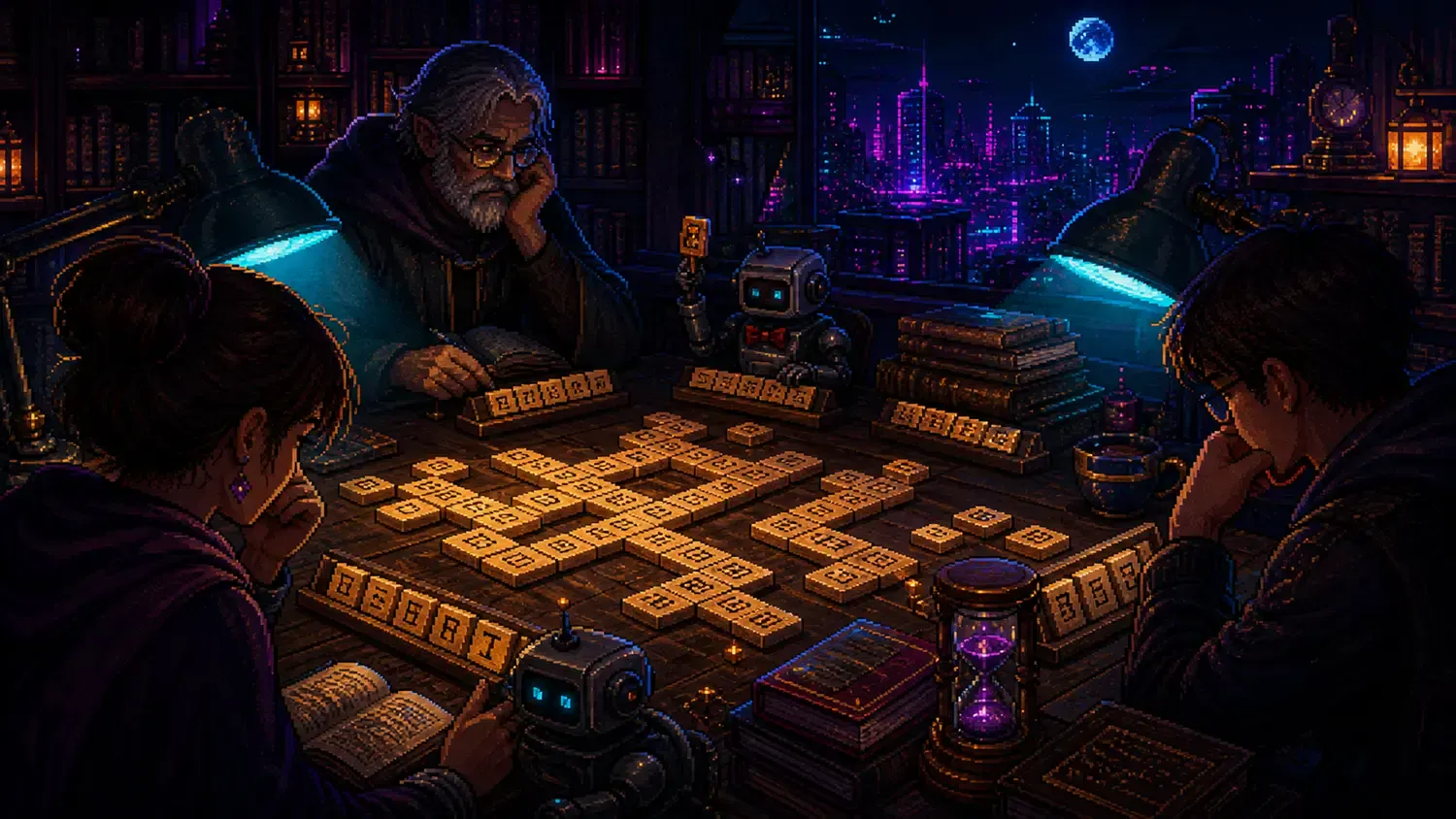
Scrabble looks like a vocabulary contest, but its foundation is mathematics. Scrabble Day is observed on April 13 in honor of the game’s inventor, Alfred Mosher Butts, who was born on that date in 1899. His most important design decision was not choosing an obscure word. It was counting how often ordinary letters appear.
An architect designs a word game
During the Great Depression, the American architect Alfred Mosher Butts developed a game that combined anagrams, crossword-style placement, chance and scoring. Early versions were called Lexiko and Criss-Cross Words.
Butts studied letter frequency in newspapers to decide how many copies of each letter the game should contain and how much each tile should be worth. Common letters needed to appear often and score modestly. Rare letters needed to create risk and reward.
Hasbro’s history of Scrabble describes that analysis as a central part of the game’s design. The basic distribution proved durable enough to survive generations of play.
From Criss-Cross Words to Scrabble
In 1948, James Brunot licensed the game, refined some rules and premium-square positions, and introduced the name Scrabble. The Strong National Museum of Play documents that transition and the game’s rise from slow early sales to a mass-market classic.
The finished design found a rare balance. Drawing tiles adds uncertainty, vocabulary creates options, and the board turns every move into a spatial problem. A strong word can be a weak play if it opens a valuable multiplier to an opponent.
Why tile values matter
High-value letters are tempting because they promise immediate points, but they can also block a rack. Good play is therefore less about knowing the longest possible word and more about using difficult letters efficiently while preserving future combinations.
That is why short words matter so much. A compact play can connect to several existing words, reach a premium square or remove an awkward tile. The board rewards placement as much as vocabulary.
Three strategic ideas that actually help
Protect flexibility
A rack containing a useful balance of vowels and consonants creates more future options. Playing every easy letter at once may leave a collection that is difficult to combine on the next turn.
Look for parallel plays
Placing a word alongside an existing one can create several short cross-words at the same time. Each valid connection adds to the score and turns a modest word into a much stronger move.
Count what is disappearing
Near the end of a game, visible tiles reveal information about what may remain on another rack. Competitive players track important letters and adjust risk accordingly. The bag is random; the available evidence is not.
Different languages create different games
Scrabble editions cannot simply translate the board and keep the same tile bag. Letter frequencies differ between languages, so distributions and values must change. A letter that is common in English may be less useful elsewhere, while accented letters can become strategic resources in another edition.
This is one reason an English strategy guide cannot be copied mechanically into every language. The central system remains recognizable, but the probability landscape changes.
Why Scrabble Day belongs on a nerd calendar
Scrabble turns language into a compact rules engine. It combines statistics, geometry, memory, probability and bluffing inside a board that can still be explained in minutes.
That hidden structure is the best way to celebrate Scrabble Day: play a game, notice which tiles create friction and remember that every value on the rack began with someone counting letters long before spreadsheets made the task easy.