
Mickey Mouse Day: Why a Third Film Became a Birthday
On November 18, 2026, Mickey Mouse turns 98 by the date of his celebrated cinema debut. Yet Steamboat Willie was the third Mickey cartoon produced. The useful question is not just why that date stuck, but what happened when the audience could hear the drawings move.
A birthday usually points towards a beginning. For a fictional character, there are several candidates: an early sketch, a completed film, a test screening or the moment a wider audience meets the character. Mickey Mouse Day compresses those different beginnings into one square on the calendar. Unpacking them leads to a more interesting anniversary than another round of familiar trivia.
Why November 18, rather than the first finished cartoon?
Disney’s official studio history places the production sequence clearly: Ub Iwerks animated two silent Mickey cartoons before the team made Steamboat Willie. The earlier films were Plane Crazy and The Gallopin’ Gaucho; a distributor had not bought the proposed silent series. The third production supplied a different proposition: coordinated sound and animation.
Steamboat Willie opened at New York’s Colony Theatre on November 18, 1928. That theatrical opening anchors the birthday. In an archive answer about conflicting dates, Disney archivist Dave Smith points to a surviving theatre programme as evidence for November 18. Production order and release order answer different questions, so there is no contradiction in an earlier film existing before the official birthday.
The distinction matters beyond Disney. A work can exist without having found its public. An anniversary often remembers the meeting between the two. Here, the date marks the point at which this particular version of Mickey could be experienced in a cinema, with its images and soundtrack working together.
The boat becomes a musical instrument
Think of the riverboat as a stage with unusually flexible equipment. Objects, machinery and bodies can become sources of rhythm. Disney’s film entry describes Mickey turning the animals aboard into instruments for a performance of Turkey in the Straw, followed by punishment in the galley. Those animal gags can feel abrasive today. Their timing can still be studied without treating every joke as timeless.
Our reading of the sequence is that the sound does more than illustrate contact. It reorganises what the setting can do. A movement starts to feel like a note; a repeated action establishes a pulse; a change of sound can become the punchline. The riverboat stops being merely a place where comedy happens and becomes part of the mechanism that produces it.
That is a useful difference between background music and tightly coordinated action. A melody laid across a scene can establish atmosphere while leaving individual gestures independent. When an accent lands with a gesture, the gesture acquires a musical role. Viewers can begin anticipating the next accent before it arrives.
Precision begins before the recording
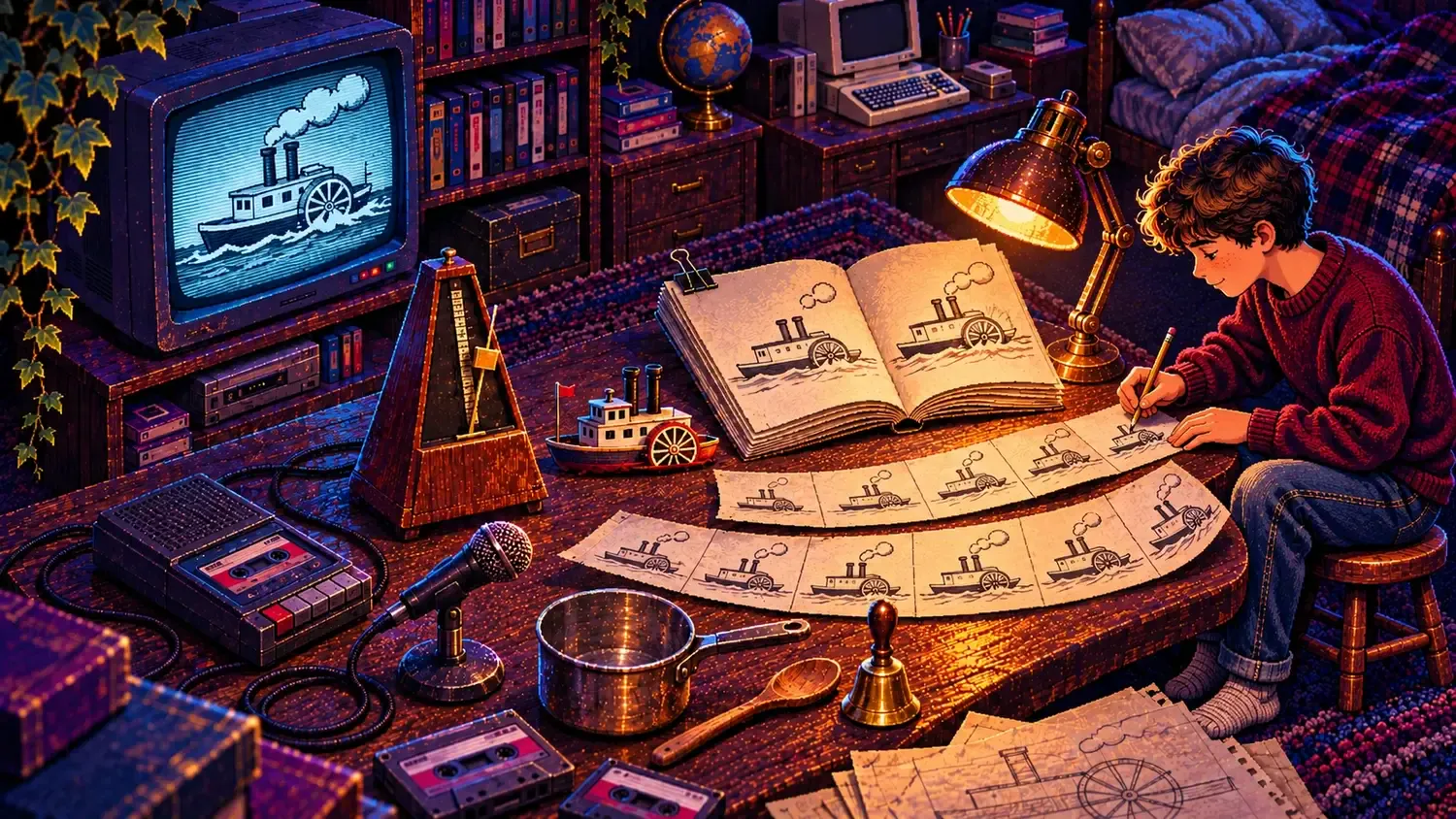
In his essay hosted by the Library of Congress, Smith describes animator Wilfred Jackson proposing a metronome and charting music and effects against the animation. Iwerks supplied almost all the animation. The important production idea is a shared timing plan: the image and the performance need a common clock.
A simple invented example makes the principle tangible. At 24 film frames per second, a steady 120 beats per minute gives two beats per second, or twelve frames between beats. An animator could plan a contact on those intervals. This is an illustration, not a claim about the tempo of Steamboat Willie. It also does not require a new drawing on every film frame; holding a drawing and advancing film frames are separate matters.
The creative choice comes next. Should the movement prepare the sound, coincide with it or finish after it? A measured pause can make an impact legible. A tiny visual preparation can tell us where to look. Precision is not simply a demand to put a noise on every motion; it gives the filmmaker control over expectation.
A breakthrough does not need an absolute “first”
The Walt Disney Family Museum’s educator material calls Steamboat Willie one of the first animated films to synchronise sound successfully. That is a more useful formulation here than declaring that animation suddenly discovered sound in November 1928. The achievement worth examining is how effectively the components work together.
It also keeps the people behind that effect in view. The name Walt Disney identifies the producer and director, but a character’s timing is made through specific animation, planning and performance work. Treating the finished film as a single flash of inspiration hides the practical decisions that make it understandable.
Try three passes through one short sequence
For Mickey Mouse Day, choose a brief sequence from the film and compare three ways of experiencing it. Use the same passage each time so that changes in the material do not disguise changes in your attention.
- Watch with the sound muted. Follow the preparation, contact and recovery of a gesture. Where does your eye expect an accent?
- Listen without looking. Notice recurring sounds, melodic patterns and pauses. Can you infer an action, or only a rhythm?
- Watch and listen together. Identify one moment where the pairing adds something neither channel supplied alone. Describe that moment precisely rather than calling the whole film “ahead of its time.”
Then imagine shifting one sound slightly later. The same gesture might appear heavier, clumsier or detached from its result. This is a thought experiment, not a reconstruction of the original production. Its value is that it makes timing available to your own observation.
The exercise pairs naturally with NerdSpot’s exploration of how Hitchcock directs attention and suspense. In both cases, a creator organises what the audience expects next. For another listening experiment, Strange Music Day asks what becomes audible when habit stops doing all the work.
What is worth celebrating after 98 years?
November 18 gives Mickey a memorable birthday, but the more durable lesson is a creative one. A promising character did not become a screen event merely by existing. A particular film found a way to make movement, rhythm and performance reinforce one another.
Celebrate the date by listening as carefully as you look. The surprise is not that a drawing can have a soundtrack. It is that the timing between them can become the character’s performance.