
Guillermo del Toro: Why We Feel for His Monsters
Guillermo del Toro turns 62 on October 9, 2026. His creatures invite a closer look: texture, gesture and unequal power can make an unfamiliar body feel vulnerable, without making it any less strange.
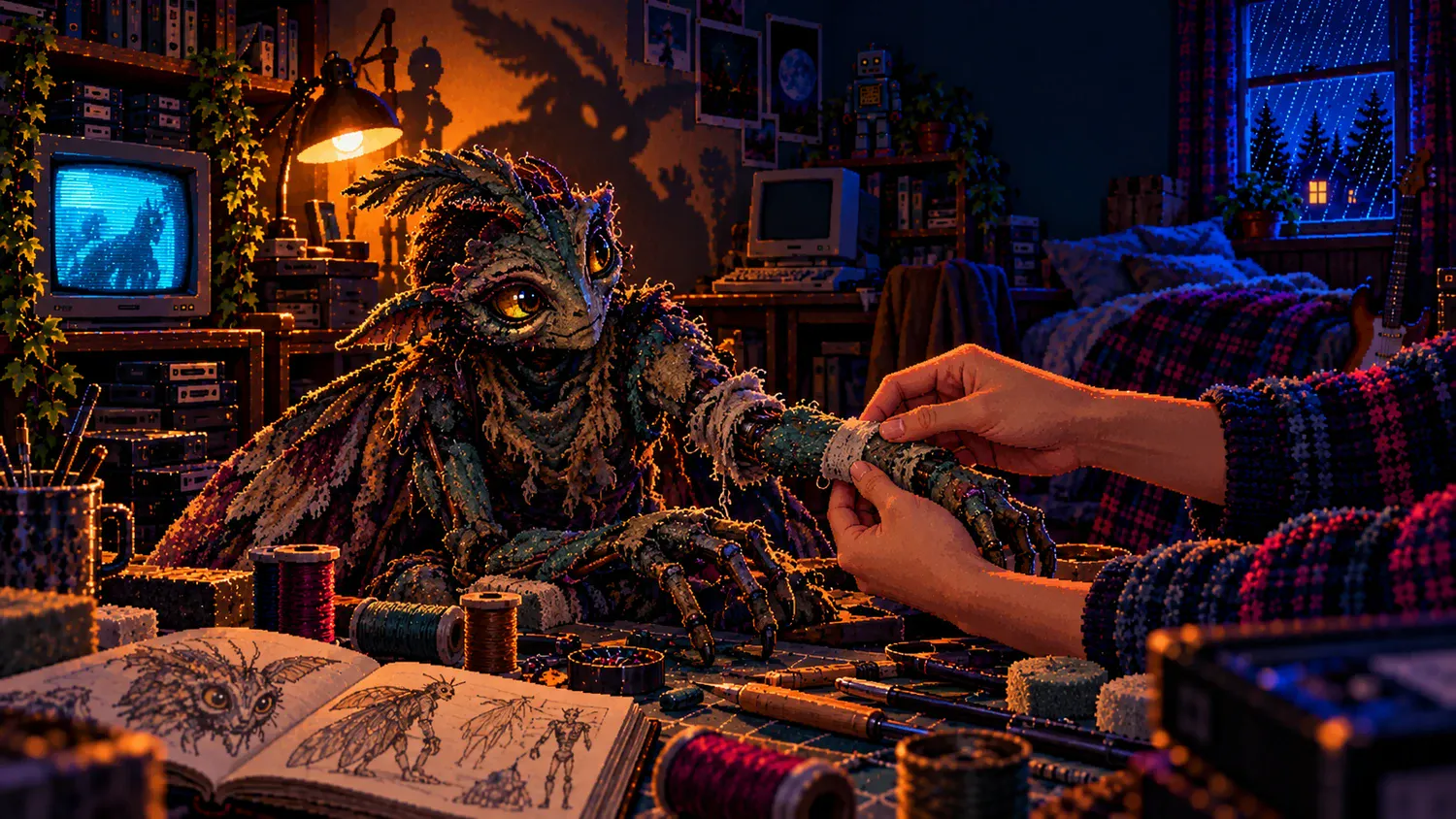
A creature can fill the screen before it becomes a character. We may register claws, an unfamiliar face or a body that moves differently, yet still know nothing about what it wants. Del Toro’s films become especially interesting when they slow down that first judgement. For his birthday, this essay follows a question through three films: what makes a strange body feel like somebody? The discussion touches on their situations and themes without revealing their endings.
A birthday, and a better question than a ranking
Mexico’s cultural information service records his birth in Guadalajara on October 9, 1964. Today, October 9, 2026, he turns 62.
The occasion appears in the Nerd Calendar. Rather than arrange a career into winners and runners-up, let us look at a recurring artistic problem. How can a film make us care about an unfamiliar being without smoothing away everything unfamiliar about it? Our reading is that del Toro connects three things: a body we can imagine touching, a gesture we can understand and a relationship that gives the gesture consequences.
Creature design begins before the creature moves
LACMA’s At Home with Monsters exhibition brought together drawings, maquettes and film art, making the material stages of del Toro’s imagination visible.
Those different objects invite different questions. A drawing can establish a silhouette. A model has to occupy space. A performing body must make a turn, carry weight and react to another presence. None of these stages automatically produces feeling, but each can make a design more specific. A generic beast announces a category; an individual creature has proportions, limitations and habits.
Consider what a surface suggests before any dialogue arrives. Roughness may imply age or exposure. A fragile joint suggests a place that can be hurt. A heavy hand makes a careful touch feel effortful. These are viewing possibilities, not a fixed dictionary of del Toro’s intentions. Their value is that they encourage us to read a body as something lived in rather than as decoration.
Pan’s Labyrinth: appearance cannot settle trust
In the 2006 film, Ofelia encounters a faun while living under her violent stepfather’s authority. The BFI’s interview with del Toro establishes that collision between fairy tale and fascist Spain.
The useful distinction is not that every monster is kind and every human cruel. Such a rule would merely replace one visual shortcut with another. The fantastic world remains unsettling. Our interpretation is that the film asks viewers to keep assessing demands and actions after an appearance has made its first impression.
Notice how authority changes an encounter. Who issues an instruction? Who must take the risk? Is the weaker person allowed to question what happens next? These questions move judgement away from horns, clothing or status and toward conduct. A recognisably human face cannot guarantee safety; an extraordinary body cannot answer every moral question for us.
The Shape of Water: attention changes the encounter
Searchlight’s synopsis places Elisa in a secret government laboratory in America around 1962. That setting gives the film’s encounter a stark imbalance of power.
A laboratory can frame a living being as a problem to classify. A relationship requires a different kind of attention: waiting for a response, noticing preference, allowing an action to mean something other than useful data. Read this as the film’s central shift in perspective. The creature does not have to become visually ordinary before an exchange can matter.
For a viewer, small gestures can therefore carry more weight than an elaborate reveal. The key question changes from what a body can do to what another person will do in its presence. Care needs duration. If a scene gives an encounter time to develop, curiosity can become recognition without eliminating unease.
Pinocchio: a made body can still have an inner life
MoMA’s Crafting Pinocchio (PDF) documented puppet-making, working sets and motion tests for del Toro’s 2022 stop-motion film. Its credits to an international team also foreground collective craft.
Pinocchio is not a monster in precisely the same sense as a threatening creature. He is useful to this comparison because his visibly constructed body makes the question of personhood impossible to avoid. A viewer knows that somebody built the object and can still experience a character making a choice.
Watch for the difference between movement and intention. Moving an arm changes a pose; hesitating before moving it can suggest uncertainty. Turning toward somebody may mean listening, asking or resisting, depending on timing and context. In this reading, the body becomes emotionally legible through decisions rather than through resemblance to a real child.
Handmade is a means, not a guarantee
It would be too easy to turn this into a contest between practical effects and digital imagery. A tangible object can be dramatically empty, while a digitally created figure can feel painfully alive. Material detail supplies opportunities; framing, performance, editing and sound determine what the audience can do with them.
The same caution applies to authorship. A director’s name gives us a useful route through a body of work, but screen creatures also depend on designers, fabricators, performers and animators. Paying attention to craft should widen the circle of recognition. The point of seeing the work is to understand how many decisions support the apparent simplicity of one expressive gesture.
Three things to notice on your next viewing
- Separate design from behaviour. What does the first image encourage you to assume, and which later action revises that assumption?
- Look for a limitation. Which movement, surface or hesitation makes the body feel capable of being hurt?
- Track who controls the encounter. Who approaches, who waits and who is allowed to refuse?
NerdSpot’s essay on Ripley’s competence and courage explores the related question of how action earns an audience’s trust. The characters differ, but the viewing habit carries across: watch what a film shows somebody doing before accepting the label attached to them.
The creature becomes somebody
On del Toro’s 62nd birthday, his monsters offer more than a gallery of memorable shapes. They invite us to reconsider the speed of our own judgement. Texture makes a body imaginable; gesture gives it intention; a relationship gives that intention stakes. Empathy begins when we stay with the unfamiliar long enough to see a choice.